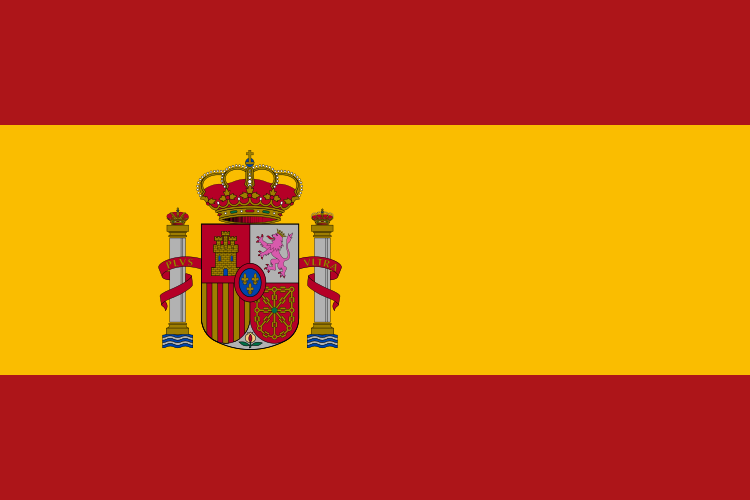
 ESP 16%
 FRA 12%
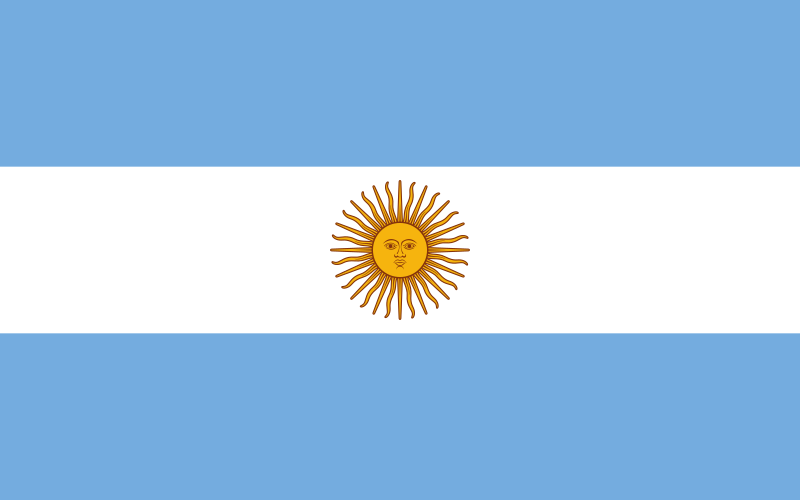 ARG 12%
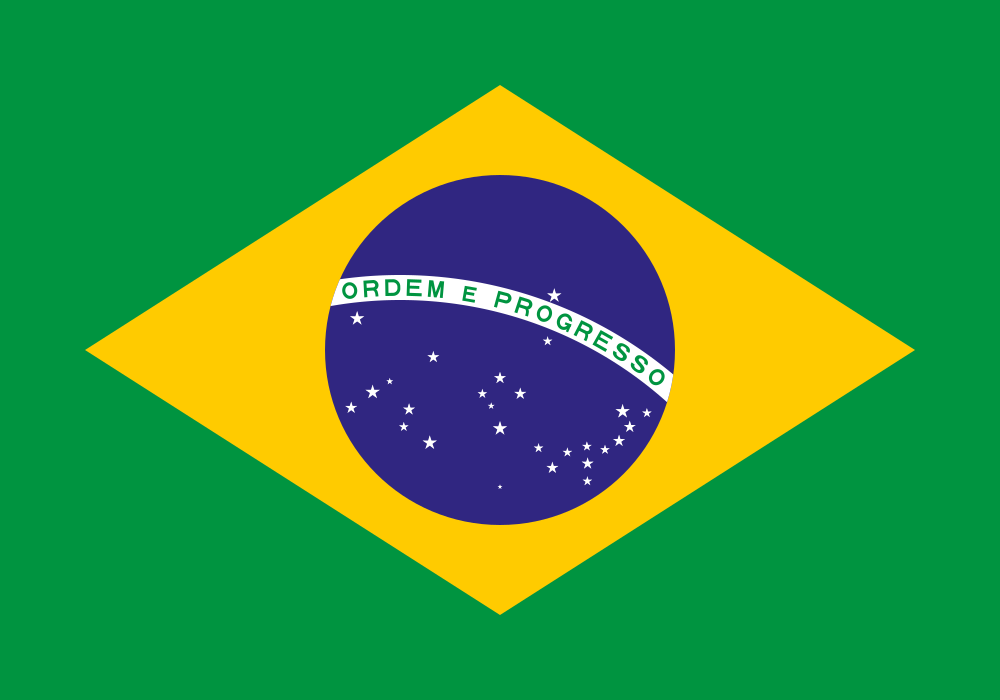 BRA 11%
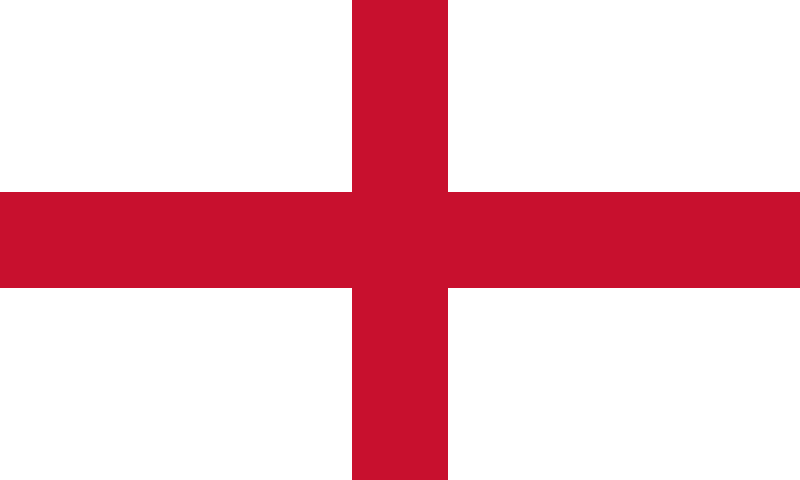 ENG 10%

Cape Verde, ranked 69th and rated 0.1% to win, outlasted Uruguay to reach the World Cup 2026 last 32, where a 1-1 draw with Argentina ended their debut run.
Cape Verde reached the Round of 32 at World Cup 2026, bowing out only after holding reigning champions Argentina to a 1-1 draw before the title holders advanced. For a nation ranked 69th in the world and priced at a rock-bottom 0.1% to lift the trophy, a knockout-stage finish on debut was a staggering overachievement, and one of the tournament's defining underdog tales.
The Blue Sharks did not merely make up the numbers in Group H. They finished second on 3 points with a goal difference of zero, slipping past Bielsa's Uruguay and Saudi Arabia to claim a place in the last 32 behind only Euro 2024 winners Spain. That alone rewrote Cape Verde's football history, and the knockout cameo against Lionel Messi's Argentina gave the debut a fitting, defiant finale.
This is the story of how the smallest nation ever to reach a World Cup got there, who carried them, how their run ended, and where a ceiling of the Round of 32 sits in the grand sweep of the 2026 tournament.
Ad
How did Cape Verde reach the World Cup 2026 knockouts?
Cape Verde's route to the knockouts ran straight through one of the tournament's most lopsided groups on paper. Group H was headed by Spain, the pre-tournament favourites at 16% title odds, and also contained Uruguay (FIFA #17) and the Saudi Arabia side that famously toppled Argentina in 2022. Cape Verde, at #69, were comfortably the lowest-ranked team in the pool.
Yet the final table told a different story. Spain cruised through as winners on 7 points with a +5 goal difference, but the second qualifying berth went to Cape Verde, who banked 3 points and a neutral goal difference of zero. Uruguay and Saudi Arabia were left behind on 2 points apiece, the Celeste undone by a -1 swing and the Saudis by a damaging -4.
The numbers reveal exactly how Cape Verde did it: control and containment rather than flair. A goal difference of zero across three matches points to a side that refused to be beaten heavily, kept games tight and took its moments. In a format where the third-placed team in several groups needed four or more points to progress, Cape Verde's disciplined return of 3 points and a clean goal difference was enough to finish a clear second.
Finishing above a Uruguay team built in Marcelo Bielsa's intense, high-pressing image was the headline result. On FIFA ranking alone, the gap was 52 places; on expectation, it was a chasm. Cape Verde closed it with organisation, and in doing so booked the first World Cup knockout tie in their history.
How did the Blue Sharks' knockout run end?
Cape Verde's reward for finishing second was a Round of 32 meeting with Argentina, the reigning world champions and one of the heavyweight favourites at 12% title odds. On every metric it was a mismatch: FIFA #3 against FIFA #69, a squad led by Lionel Messi against a side making its first knockout appearance at a World Cup.
What followed was the performance of Cape Verde's tournament. The Blue Sharks held Argentina to a 1-1 draw, trading blows with the champions and refusing to buckle under the pressure that eventually broke so many higher-ranked sides. It took Argentina's superior depth to see them over the line and into the Round of 16, where they edged Egypt 3-2 before marching all the way to the final.
For Cape Verde, there was no shame in the manner of the exit. Pushing a team of Argentina's calibre to the wire, rather than being swept aside, was emphatic proof that their group-stage results were earned rather than fortunate. The scoreline flattered nobody and embarrassed Cape Verde not at all.
The run ended at the first knockout hurdle, but the context matters: the side that eliminated them reached the showpiece. Cape Verde's tournament closed against the eventual finalists, a detail that dignifies the whole adventure.
Who were Cape Verde's key players?
Cape Verde's World Cup was a triumph of the collective rather than the individual. No Blue Shark appears anywhere near the tournament's top-scorer chart, which was led by Kylian Mbappe's 10 goals ahead of Messi, Erling Haaland and Jude Bellingham. Cape Verde's success was built the other way round: on shared responsibility and defensive structure.
That identity is written into the data. A group-stage goal difference of zero means the attack produced just enough while the back line kept the damage to a minimum, and holding Argentina to a single goal in the knockouts underlined where the team's real strength lay. This was a side organised to frustrate, to stay compact, and to make every higher-ranked opponent work for their chances.
Like many of the tournament's debutants, Cape Verde drew heavily on a European-based diaspora, players schooled in competitive leagues who brought professionalism and tactical discipline to the islands' cause. The absence of a single marquee goalscorer did not hold them back; if anything, the lack of reliance on one star made them harder to plan against.
In a World Cup where individual brilliance from Mbappe, Messi and Haaland shaped the biggest nights, Cape Verde offered the counter-argument: a team can overachieve on coherence alone. Their key player, in effect, was the unit.
How did Cape Verde defy the odds?
To grasp the scale of Cape Verde's achievement, start with the pre-tournament numbers. At 0.1% title odds they were tied for the longest shots in the entire 48-team field, level with fellow minnows Curacao, Haiti and New Zealand. Their FIFA ranking of 69 placed them firmly among the tournament's makeweights.
Group H alone illustrated the mountain they climbed. Spain were rated at 16% to win the whole thing, Uruguay at 4%, and even Saudi Arabia carried double Cape Verde's title odds at 0.2%. Cape Verde were not just outsiders to progress; they were statistically the least likely team in their group to do anything at all.
They answered with results. Finishing above Uruguay, a team priced 40 times higher to win the tournament, is the kind of upset that reframes a nation's footballing standing. Reaching the knockouts and then matching Argentina blow for blow for 90 minutes made the point unarguable.
Underdog runs are the lifeblood of a World Cup, and Cape Verde's belongs in the conversation with the tournament's other great overachievers. The difference between them and most Cinderella stories is the quality of the opposition they overcame to get there.
How far could Cape Verde realistically go?
In hard terms, the Round of 32 was always likely to be Cape Verde's ceiling, and reaching it was already a wild overperformance. A team ranked 69th, with no established goalscorer and the joint-lowest title odds in the field, was never going to be built to grind through multiple knockout rounds against the game's elite.
The draw sharpened that reality. Second place in Group H funnelled them straight into Argentina, the reigning champions and eventual finalists. Even a kinder bracket would have demanded two or three wins over seeded opposition to reach the latter stages, a stretch beyond a squad whose strength was containment rather than cutting edge.
Where Cape Verde exceeded the realistic ceiling was in the manner of their exit. Many expected the knockouts to expose them; instead they took Argentina to a 1-1 draw, a result that said more about their progress than the final scoreline against Spain's conquerors ever could. The margin between dignified exit and genuine upset was narrower than their ranking suggested.
Judged honestly, Cape Verde maximised what a nation of their size and resources could extract from a first World Cup. The last 32 was the realistic summit, and they reached it while making the champions sweat on the way out.
What Cape Verde's run means for the future
Cape Verde arrived at World Cup 2026 as the smallest nation ever to reach a World Cup, and they leave it with a knockout appearance and a group-stage finish above Uruguay and Saudi Arabia. That is a legacy no amount of future results can erase, and a foundation the islands' football can build on.
The template they established, defensive organisation, a diaspora-fuelled squad and fearlessness against ranked opposition, is a repeatable blueprint for small nations in the expanded 48-team format. Cape Verde proved that qualification need not mean humiliation, and that a tight, well-drilled collective can out-think more celebrated opponents.
For the players and the federation, the knockout run is both reward and springboard. Having tasted the last 32 and gone toe-to-toe with Argentina, the bar for the next campaign is set higher, and the belief that they belong on this stage is no longer theoretical.
Cape Verde's 2026 was brief in the grand arc of the tournament, which ultimately came down to Spain and Argentina, but it was anything but forgettable. The Blue Sharks turned a debut most expected to be a cameo into one of the competition's warmest stories.
Frequently asked
How far did Cape Verde get at World Cup 2026?
Cape Verde reached the Round of 32, the first knockout round. Their debut run ended there after a 1-1 draw with Argentina, with the reigning champions advancing.
How did Cape Verde reach the knockout stage?
They finished second in Group H with 3 points and a goal difference of zero. That put them above Uruguay (2 points) and Saudi Arabia (2 points), behind only group winners Spain.
Did Cape Verde finish above Uruguay?
Yes. Cape Verde edged Bielsa's Uruguay in the Group H table, 3 points to 2, despite Uruguay sitting 52 places higher at FIFA #17 against Cape Verde's #69.
Who were Cape Verde's key players at World Cup 2026?
No individual Blue Shark featured on the tournament's top-scorer chart; their strength was a tightly organised, diaspora-built collective and a defence that conceded sparingly in the group.
Why was Cape Verde's run considered historic?
Cape Verde are the smallest nation ever to reach a World Cup, and 2026 was their debut. Rated at just 0.1% to win the title, they reached the knockout rounds against every expectation.