 ESP 16%
 FRA 12%
 ARG 12%
 BRA 11%
 ENG 10%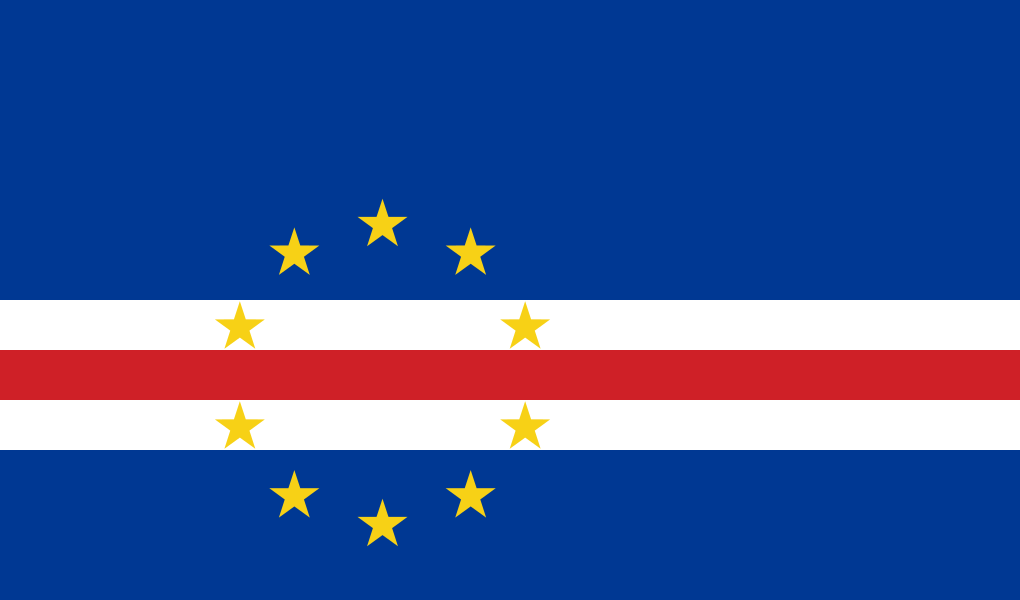

Cape Verde's World Cup 2026 run ended in the Round of 32, but the debutants finished above Uruguay and pushed reigning champions Argentina to penalties.
Cape Verde's first World Cup ended in the Round of 32, but not before the Blue Sharks delivered one of the tournament's defining underdog stories. The FIFA #69 debutants finished second in Group H, above Uruguay and Saudi Arabia, then held reigning champions Argentina to a 1-1 draw before going out on penalties. For a nation given just a 0.1% title chance before a ball was kicked, reaching the last 32 and pushing the eventual finalists to the brink was a triumph in every sense that matters.
The scale of the achievement is easy to understate. Cape Verde arrived as one of the smallest footballing nations ever to reach the finals, a squad assembled largely from the diaspora playing across Europe's leagues. They were drawn into a group headed by Euro 2024 winners Spain and containing Marcelo Bielsa's intense Uruguay, ranked FIFA #17. On paper, a single point looked optimistic. Instead, the Blue Sharks banked three and progressed as runners-up.
This is the full account of how Cape Verde's run unfolded: the group-stage overachievement, the individuals who drove it, the near-miss against Lionel Messi's Argentina, and an honest look at just how far this side could realistically have gone. Their story is the clearest evidence yet that the expanded World Cup can hand its stage to nations that never had it before.
Ad
How did Cape Verde's World Cup 2026 run unfold?
Cape Verde's tournament ran through two acts: a group stage that defied their ranking, and a knockout tie that came within a whisker of a place in the last 16. They finished second in Group H on 3 points with a neutral goal difference, trailing only Spain, who topped the pool on 7 points. Behind Cape Verde came Uruguay on 2 points and Saudi Arabia, also on 2, both of whom entered the tournament as heavier names.
Progressing from that group was the platform for everything that followed. As a Group H runner-up, Cape Verde earned a Round of 32 meeting with a group winner from elsewhere in the bracket, and the draw handed them Argentina, ranked FIFA #3 and reigning world champions. It was the kind of tie a debutant nation dreams of and dreads in equal measure.
What the Blue Sharks produced was a performance that erased any suggestion they were merely happy to be there. They matched Argentina for long stretches and forced a 1-1 scoreline that took the tie to a penalty shootout. Argentina, with all their tournament pedigree, needed spot-kicks to see off the newcomers and advance. Cape Verde went out, but they left with their reputation transformed.
The context makes the run look even better in hindsight. Argentina did not stumble after surviving that scare; they marched all the way to the final, losing only on the biggest stage to Spain in a goalless decider. Being separated from a proper world power by the width of a shootout, against the side that reached the final, is a marker Cape Verde will carry for years.
How did Cape Verde finish above Uruguay in Group H?
The single most striking line on Cape Verde's tournament CV is that they finished above Bielsa's Uruguay. The gap in FIFA ranking between the two nations was enormous, and Uruguay were widely tipped to accompany Spain into the knockouts. Instead it was the debutants who claimed second, with Uruguay and Saudi Arabia both eliminated on 2 points apiece.
Cape Verde did it by being difficult to beat and clinical with their moments. Their neutral goal difference across three games points to a side that defended with discipline and organisation rather than one that overwhelmed opponents. Against higher-ranked teams, that structure was the foundation: keep the game tight, deny space, and take the chances that came. It is a template smaller nations have used before, executed here with unusual composure.
The ranking gulf across the group frames just how far Cape Verde punched above their weight. Spain sat at FIFA #2 and Uruguay at #17, while the Blue Sharks came in at #69, only marginally above Saudi Arabia at #61. To emerge second from that field was not a fluke of a single result but the product of three assured performances.
There is a psychological dimension too. For a squad drawn from clubs scattered across Europe, gelling quickly into a coherent unit at a first World Cup is no small feat. Cape Verde looked settled from the outset, and that cohesion, more than any individual flourish, is what carried them past more storied opponents.
Who were Cape Verde's key players?
Cape Verde's run was built on collective identity rather than a single superstar, but a spine of experienced professionals set the tone. Ryan Mendes, a forward with years of service to the national team, offered leadership and quality in the final third, while winger Garry Rodrigues brought the kind of directness and dribbling that unsettled bigger defences. Their experience in European football was invaluable on the game's grandest stage.
In midfield, Kenny Rocha Santos and the industry around him gave the side control and balance, allowing Cape Verde to soak up pressure and spring forward when the moment arrived. The veteran Bebé, a well-travelled attacker, added a nerveless presence and a goal threat that opponents could not ignore. This was a group that had grown together through qualifying and trusted its structure implicitly.
At the back, defender Roberto 'Pico' Lopes anchored a resolute unit, and goalkeeper Vozinha proved a dependable last line, never more so than when the Blue Sharks needed to keep games alive. It was defensive reliability, as much as attacking flair, that defined Cape Verde's tournament and made them so awkward to break down.
Overseeing it all was coach Pedro 'Bubista' Brito, whose management of a diaspora-heavy squad turned a collection of individuals into a genuine team. His pragmatic, well-drilled approach was perfectly suited to a debutant nation punching above its weight, and the results in Group H and against Argentina were the vindication of that method.
The Argentina tie: how close did Cape Verde come?
The Round of 32 meeting with Argentina was the defining night of Cape Verde's World Cup. Facing the reigning champions and a squad still built around Lionel Messi, who finished the tournament with eight goals, the Blue Sharks refused to sit back and absorb. They took the game to Argentina, forced a 1-1 draw across the 90 minutes and extra time, and dragged one of world football's superpowers into a penalty shootout.
Shootouts are cruel, and this one went Argentina's way. But the manner in which Cape Verde earned it spoke volumes. This was not a smash-and-grab or a backs-to-the-wall survival act rewarded with a lucky point; it was a genuine contest in which the debutants held their own against a nation with a title to defend. Argentina were made to sweat by opponents they were expected to brush aside.
The significance grew as the tournament progressed. Argentina did not fade after that scare, beating Egypt, Switzerland and England on their way to the final before losing a goalless decider to Spain. Cape Verde, in other words, ran the beaten finalists to penalties. Few of the eliminated nations at World Cup 2026 can point to a defeat so honourable.
For the players and supporters, the tie will be remembered less as an exit than as a statement. Cape Verde proved they belonged on the same pitch as the very best, and they did so in the tournament's knockout rounds, where reputations are made. It was the perfect distillation of their entire campaign.
How far could Cape Verde realistically have gone?
Judged against pre-tournament expectations, Cape Verde had already exceeded their ceiling before the knockouts began. A nation ranked FIFA #69 with title odds of 0.1% was not expected to survive a group with Spain and Uruguay, let alone win it comfortably enough to progress. Reaching the Round of 32 was the realistic upper limit of most projections, and the Blue Sharks met it.
The Argentina tie is where the what-ifs live. Win that shootout and Cape Verde would have reached the last 16 at their first attempt, a landmark that would have placed them among the tournament's genuine surprise packages. The margin was that fine. But the draw that rewarded them for topping expectations in the group also handed them the toughest possible opponent, and there is no shame in falling to the eventual finalists on penalties.
Push further and the realism kicks in. Beyond Argentina lay a bracket stacked with heavyweights, and a deep run would have required a squad with more strength in depth than a debutant nation of Cape Verde's size could plausibly carry. The group they beat out was arguably a friendlier test than the gauntlet the knockout draw promised thereafter.
The honest verdict is that Cape Verde reached, and very nearly bettered, the peak available to them. A last-16 place was within touching distance and would have felt like the natural reward for their run. That they came so close, against such opposition, is the measure of how well they performed rather than a mark of what they left behind.
What does Cape Verde's run mean for the future?
Cape Verde leave World Cup 2026 with something no ranking can capture: proof of concept. A nation of limited resources, drawing on players spread across Europe, showed it could not only qualify for the finals but compete deep into them. That blueprint, organisation, cohesion and fearlessness against bigger names, is one other emerging football nations will study closely.
The expanded 48-team format was designed in part to widen the World Cup's map, and Cape Verde are among its clearest success stories. Rather than making up the numbers, the Blue Sharks finished above two more established sides and troubled the eventual finalists. That is the kind of result that justifies the tournament's growth and inspires the next generation of small-nation hopefuls.
There is a squad-building question ahead. Several of the players who drove this run were experienced campaigners, and the challenge for the federation will be renewing that core while retaining the identity that made them so hard to beat. The diaspora talent pool that supplied this team remains a strength, and continuity in coaching and structure will matter.
For now, though, this is a moment to be savoured rather than dissected. Cape Verde arrived at their first World Cup as long shots and left as a name the football world respects. Finishing above Uruguay and taking Argentina to penalties is a legacy the Blue Sharks will carry into every campaign to come, and the standard against which their future sides will be measured.
Frequently asked
How far did Cape Verde get at the 2026 World Cup?
Cape Verde reached the Round of 32 on their tournament debut. They lost to reigning champions Argentina, who won on penalties after a 1-1 draw.
Did Cape Verde qualify from their group at World Cup 2026?
Yes. Cape Verde finished second in Group H on 3 points with a neutral goal difference, above both Uruguay and Saudi Arabia, and behind only Spain.
Who knocked Cape Verde out of the 2026 World Cup?
Argentina eliminated Cape Verde in the Round of 32, edging a 1-1 tie on penalties. Argentina went on to reach the final against Spain.
Was 2026 Cape Verde's first World Cup?
Yes. The Blue Sharks, ranked FIFA #69, were making their debut at a World Cup, making their run to the last 32 a landmark in the nation's football history.
Who are Cape Verde's key players?
Cape Verde relied on a core of European-based professionals including Ryan Mendes, winger Garry Rodrigues, veteran Bebé, midfielder Kenny Rocha Santos and defender Roberto 'Pico' Lopes, with Vozinha in goal.