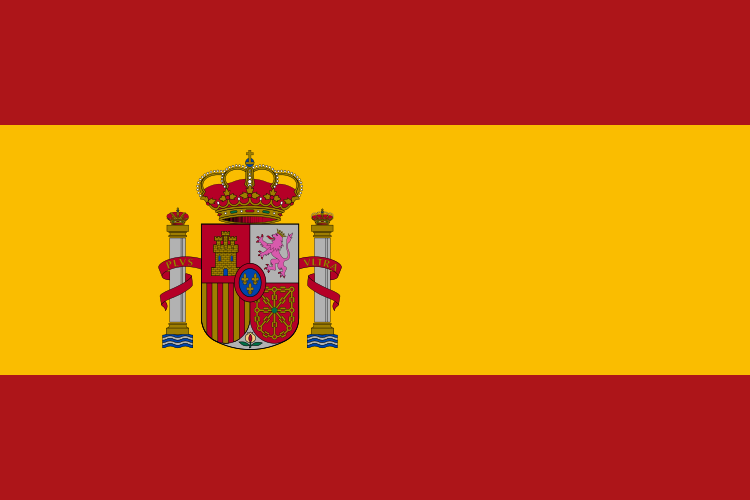
 ESP 16%
 FRA 12%
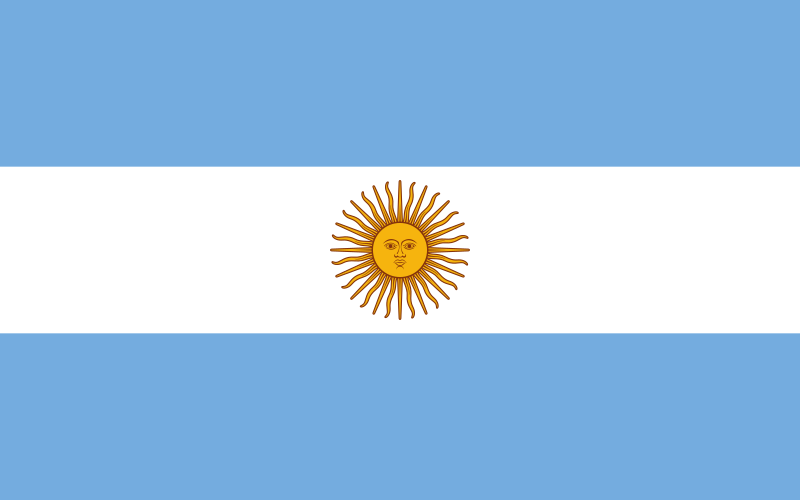 ARG 12%
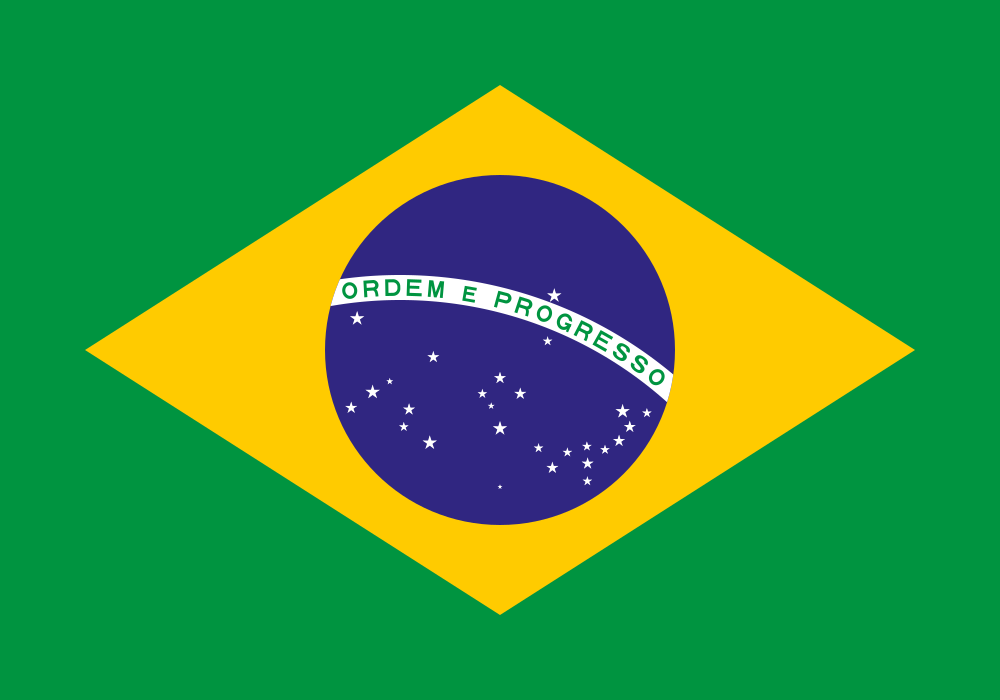 BRA 11%
 ENG 10%
Every World Cup 2026 favourite has a pressure point: Spain's missing No.9, France's Mbappe reliance, Brazil's knockout curse and England's caution.
The six clear favourites for World Cup 2026 each carry one specific, exploitable weakness. Spain (16% title odds, FIFA #2) lack a proven elite No.9 to finish their dominance; France (12%, FIFA #1) lean too heavily on Kylian Mbappe; Argentina (12%, FIFA #3) are asking an ageing core to defy the calendar; Brazil (11%, FIFA #6) cannot shake a knockout-round fragility; England (10%, FIFA #4) too often retreat into caution; and Germany (8%, FIFA #10) still lack the reliable striker to convert their dazzling creativity. Identify the pressure point, and you have the blueprint to knock each one out.
Favouritism is its own burden at a World Cup, and the expanded 48-team format only sharpens the stress. More group games and an extra knockout round mean more chances for a heavyweight to have an off night against opposition with nothing to lose, the kind of banana skin that ended fancied runs in past tournaments. The contenders who win in 2026 will be the ones who patch their flaw before an opponent forces it into the open.
What follows is not a list of vague worries but a clear-eyed audit of where each of the top six is most likely to break. The common thread is that every one of these weaknesses is structural rather than accidental: a gap in the squad, a dependence on one man, or a habit of mind that resurfaces under tournament pressure. None is fatal on its own, but each is the thing a smart coach will plan around in a one-off knockout tie.
The title-odds market frames the hierarchy neatly, and it is worth keeping in view as the pressure points are unpicked.

Spain: can the favourites cope with being the favourites?
Spain top the market at 16% and sit at FIFA #2, the heaviest favourites in the field and the reigning European champions. Their pressure point is twofold: the weight of being the team everyone else measures themselves against, and a squad that dominates the ball without an out-and-out centre-forward of the very top tier to punish the chances they create. When a possession side cannot reliably finish, it can be frustrated, sat against, and beaten on a single counter.
The strength is obvious and real. No team controls midfield or recycles possession quite like La Roja, and few opponents can live with their passing rhythm for 90 minutes. That is precisely why the finishing question matters so much. A side that monopolises the ball needs ruthless conversion, because the games it loses tend to be the ones where it has 25 shots, no goals, and concedes once. In knockout football, that profile is the difference between champions and a quarter-final post-mortem.
Then there is the psychology of favouritism. Spain arrive expected to win, and expectation changes how teams defend against them: deeper blocks, more cynicism, more time-wasting, all designed to drag a passing side into a slog. The 2024 Euros showed Spain can break those blocks, but a World Cup is longer and the margins thinner. If a striker takes ownership of the half-chances, Spain are worthy favourites; if not, the gap between 16% on paper and lifting the trophy will feel very wide.
The verdict: Spain have the best platform of any contender, but they are one cold evening in front of goal away from an early exit that the rest of the field is quietly banking on.
France: what happens when Mbappe is contained?
France are the FIFA #1 side and 12% second-favourites, yet their flaw is the most talked-about in the field: an attack built around Kylian Mbappe to a degree that makes them readable. Shut down the supply to him, double up on the channel he attacks, and you do not merely reduce France's best player, you blunt their entire plan A. That is a far more inviting target than a side with three or four equally dangerous routes to goal.
It is a strange vulnerability for a team ranked top of the world, but the ranking partly reflects depth and consistency in qualifying rather than tournament unpredictability. France have the individual talent to win any match, and on his day Mbappe is unstoppable regardless of the plan against him. The risk is the day he is quiet. Great tournament sides have a second and third scorer who step up when the talisman is marked out, and that is the layer France most need to prove they have.
The market's gap tells the story. France are FIFA #1 but trail Spain's 16% at 12%, a sign that bookmakers see the single-point-of-failure risk as real. A favourable run can paper over it, but the closer France get to the final stages, the more likely they are to meet a coach willing to sacrifice his own attack to smother Mbappe and gamble that nobody else in blue punishes him.
The verdict: France win the trophy if a supporting cast emerges; they go home early if a disciplined opponent makes the tournament a referendum on one player.
Argentina: can an ageing core defy the clock?
The reigning champions are 12% shots and FIFA #3, and their pressure point is time itself. Retaining a World Cup is one of the rarest feats in the sport, and Argentina are attempting it with a spine that has aged four years since their 2022 triumph. Across a 48-team tournament with more matches than ever, the question is whether the legs that carried them in Qatar can sustain the same intensity in the heat of a North American summer.
Argentina's great asset is know-how. This is a group that has won a World Cup and Copa Americas, that does not panic in tight games, and that manages knockout ties with rare composure. Experience wins tournaments, but only if it is matched by physical reserves in the closing 30 minutes of attritional matches. The danger is a quarter or semi-final that goes to extra time against a younger, fresher side happy to make the game a test of stamina.
There is an emotional dimension too. An Argentina built around a celebrated, ageing leadership group carries enormous expectation at home and a sense that this is a closing window. That can inspire, as it did in 2022, or it can weigh, particularly if early matches are scratchy and the narrative turns to whether the core has one more run in it. Managing minutes and rotation through the group stage will be as important as anything Argentina do with the ball.
The verdict: Argentina have the temperament to go all the way again, but the calendar is the opponent they cannot out-think, and a single sapping knockout tie could expose it.
Brazil: will the knockout curse strike again?
Brazil are 11% fourth-favourites and FIFA #6, but their weakness is written into recent history: the most successful nation in the sport has not won the World Cup since 2002. A run of knockout-stage exits, several of them against European opposition, has hardened into a genuine mental block, the sense that this gifted football nation tightens up precisely when the stakes peak. That is the pressure point every opponent in the bracket will be counting on.
Carlo Ancelotti's appointment is meant to be the answer, and it is a serious one. Few coaches in the world have his record in elimination football or his calm in finals. But a new manager bedding in a national side has limited time on the training ground, and the first tournament of a project is often about discovering whether the ideas survive contact with knockout pressure. Brazil have the attacking talent to overwhelm anyone in a group; the doubt is what happens at 0-0 in a last-eight tie with the old anxieties circling.
The talent gap between Brazil and most of the field remains enormous, which is exactly why the repeated near-misses sting. This is not a team that loses because it is outclassed; it loses tight games it should manage. Ancelotti's task is psychological as much as tactical: to convince a squad carrying two decades of knockout scar tissue that this tournament is different. If he does, 11% looks generous.
The verdict: Brazil have the squad of champions and a manager who wins finals, but until they break the knockout hoodoo on the pitch, the curse is the story, and rivals will play on it.
England under Tuchel: will caution cost them again?
England are 10% shots and FIFA #4, with a wait for a major trophy now stretching towards 60 years. Their pressure point is temperament rather than talent: a recurring tendency to retreat into caution in the biggest matches, to protect a lead or a stalemate rather than press home the quality that fills the squad. Thomas Tuchel was hired precisely to break that habit, and his first World Cup is the test of whether he can.
The raw materials are not the problem. England consistently field one of the deepest squads in the competition, rich in Premier League and Champions League experience across every line. That depth should be a weapon in a long tournament. Too often, though, the team has played as if afraid to lose, sitting on narrow margins and inviting pressure, until a single moment or a penalty shootout decides matters against them. Caution turns favourites into hostages.
Tuchel's reputation is for clarity and ruthlessness, and the early signs of his tenure will be judged on whether England take the initiative in matches they are expected to win rather than waiting to be asked questions. The expanded format gives England a kinder early run, but it also means more knockout rounds in which the old reflex could resurface. Converting territory and possession into goals, and trusting the front players to chase a second goal rather than guard a first, is the behavioural shift that defines their ceiling.
The verdict: England have the squad to win it and a manager paid to be braver than his predecessors; if the caution returns under pressure, so does the familiar heartbreak.
Germany: brilliant creators, but who finishes?
Germany are 8% shots and FIFA #10, the outsiders of this top six but a side capable of beating anyone on their day thanks to a midfield bursting with creativity around Florian Wirtz and Jamal Musiala. Their pressure point is the mirror image of their strength: for all that invention, they lack a dependable, world-class No.9 to turn a stream of chances into goals. A team that creates and does not convert lives dangerously in tight knockout games.
The German revival is real and exciting. Few sides can match the speed of thought and combination play their young creators bring, and on flow they can dismantle deep defences. But chance creation without a clinical finisher is the same trap that threatens Spain, and Germany feel it more acutely because their margin for error is thinner at 8% than the sides above them. Against organised opposition that defends the box well, the absence of a ruthless centre-forward can leave all that midfield brilliance unrewarded.
There are questions at the other end too. A young, attack-minded side can be vulnerable in transition and short of on-field leadership when matches turn scrappy, the moments when tournaments are often decided. Germany's history says they tend to find a way deep into competitions, but this iteration is more about flair than the streetwise control of past German teams. Balancing the creativity with defensive discipline is the fine line between a thrilling run and an early upset.
The verdict: Germany are the most watchable of the favourites and a live dark-horse threat, but without a striker to finish the chances Wirtz and Musiala manufacture, their ceiling is capped below the very top.
Frequently asked
Who is the favourite to win the 2026 World Cup?
Spain are the outright favourites at 16% title odds, comfortably clear of France, Argentina (both 12%) and Brazil (11%). They are also ranked FIFA #2 and arrive as reigning European champions.
Why is France ranked number one but not the outright favourite?
France top the FIFA rankings at #1 but sit at 12% title odds, behind Spain's 16%. Markets weigh squad balance and tournament form, and France's heavy reliance on Kylian Mbappe makes them more containable than their ranking suggests.
Which World Cup 2026 favourite has the most dangerous weakness?
Spain's missing centre-forward is the most exploitable flaw given they are favourites at 16%, because a possession side that cannot finish can be frustrated. Brazil's knockout fragility runs it close.
When did Brazil last win the World Cup?
Brazil last won the World Cup in 2002. Despite being five-time champions and 11% favourites in 2026, a run of knockout-stage exits is the pressure point Carlo Ancelotti must fix.
Can Argentina win back-to-back World Cups in 2026?
Argentina are 12% shots and FIFA #3, but retaining the title is historically rare and their spine is ageing. Whether the core can sustain intensity across a 48-team tournament is the question over their bid.