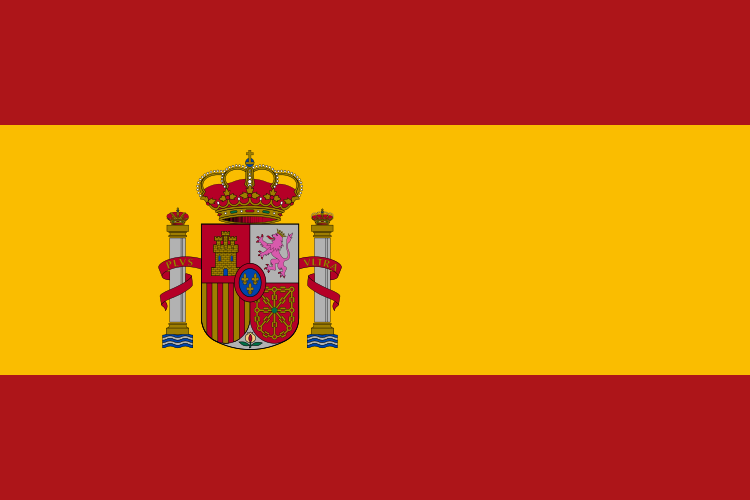
 ESP 16%
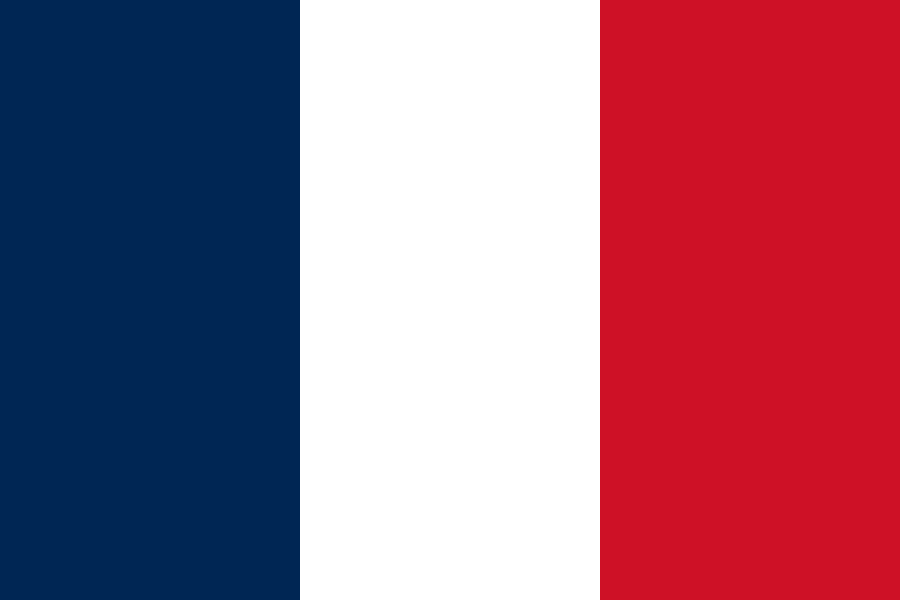 FRA 12%
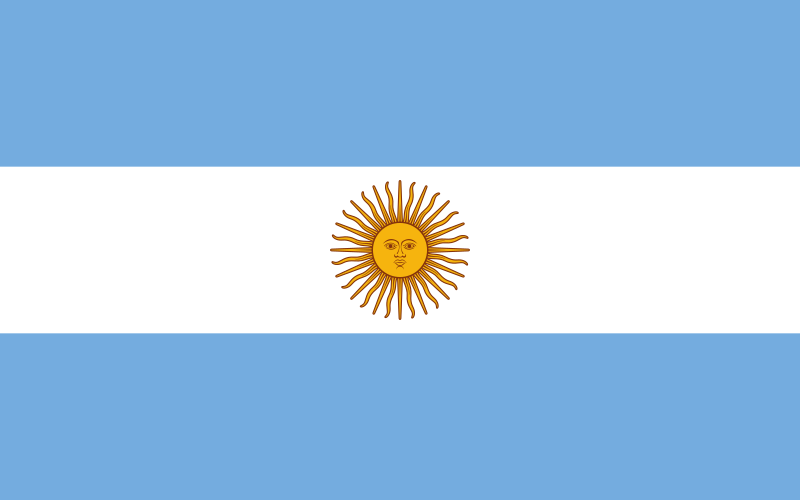 ARG 12%
 BRA 11%
 ENG 10%

The 2026 World Cup Fair Play Award rewards the cleanest disciplinary record, not the best team. Here is why Egypt fit the model and the market underrated them.
Our pick for the 2026 World Cup Fair Play Award is Egypt, and the reasoning is simple: this market rewards the cleanest disciplinary record among serious contenders, not the flashiest squad, and Egypt were a compact, organised side that reached the Round of 16 while the market barely acknowledged them. The casual reader looks at the trophy lift and reaches for Spain or Argentina; the sharp reader reads the rulebook first and finds an outsider hiding in plain sight.
The Fair Play Award is the one World Cup market where being brilliant is almost beside the point. It is a discipline contest. That flips the usual logic on its head: the teams that dominate the title conversation are often the ones committing the tactical fouls, collecting the cynical yellows and stopping counters at any cost. Egypt, by contrast, defended in a structured block, stayed on their feet and did not need to hack opponents down to survive.
Egypt reached the last 16 before losing a 3-2 thriller to Argentina, which matters enormously here. It gave them a full run of competitive, high-pressure knockout football to be judged on while keeping their record clean. That is exactly the profile the model wants, and it is why the market should have rated the Pharaohs far higher than it did.
Ad
How is the World Cup Fair Play Award actually decided?
Start with the mechanics, because they drive everything. The Fair Play Award is scored on disciplinary conduct: yellow cards, red cards and overall respect for the game and opponents. It is not a vote on style or a reward for goals. A team that plays 300 clean minutes and commits few fouls will beat a more talented side that racks up bookings, every single time.
The second rule the market ignores is eligibility by depth. In practice this trophy is contested by the teams that reach the knockout rounds, because those sides are assessed over a larger, more meaningful sample of matches. A nation dumped out in the group stage simply does not have the body of work to win it. That quietly removes two thirds of the field before you even look at cards.
So the model is a two-step filter. First, isolate the teams that reached the Round of 16. Second, within that group, back the most structurally disciplined, lowest-foul side, not the deepest run or the biggest name. Do that honestly and you stop staring at the finalists and start noticing the organised, unglamorous teams that quietly kept their sheets clean.
This is where recency bias hurts most readers. They anchor on the Spain 0-0 Argentina final and assume the champions or runners-up must scoop every award. But a goalless, cagey final is exactly the kind of tense, foul-heavy match that damages a disciplinary score. The Fair Play Award is frequently won away from the podium.
Why did Egypt fit the Fair Play model better than the market thought?
Egypt clear the first filter comfortably: they finished second in Group G on five points with a positive goal difference, then earned their place in the last 16, where Argentina needed a 3-2 win to see them off. That is a genuine knockout-stage side, not a group-stage also-ran, so they are firmly inside the eligible pool.
On the second filter, style is the tell. Egypt were built to defend in a compact, disciplined shape and to frustrate rather than to press manically and give away fouls. Salah's Pharaohs did their damage on the transition, which means they spent less time lunging into rash challenges and reckless tackles that generate cards. Organised African sides with a clear defensive plan are consistently among the lowest-foul teams at major tournaments, and Egypt fit that mould.
Contrast that with the sides the market fixated on. Argentina and Spain ground through tense, physical knockout ties where professional fouls and game management are part of the toolkit. High-pressing teams generate fouls by design. Egypt did not need to, and that is precisely the edge a disciplinary market rewards.
The market's mistake was reading Egypt as a modest team with a modest ceiling and pricing them out of a trophy that has nothing to do with ceiling. In a contest decided by cards, being unglamorous but organised is a feature, not a flaw.
Which Round-of-16 teams were the real Fair Play threats?
Once you apply the eligibility filter, the contenders are the sixteen sides that reached the last 16: the likes of France, Spain, Argentina, Portugal, Morocco, Switzerland, England, Colombia, the United States, Mexico, Canada, Paraguay and Egypt. That is the honest shortlist, and most of the pre-tournament favourites for this specific market sit inside it.
The chart below shows the FIFA ranking of a cross-section of those Round-of-16 sides. Note how it tells you nothing about their discipline. Portugal and Colombia carry glossy rankings, yet pedigree is not what wins this trophy; conduct is. The chart is a useful reminder that the market keeps pricing this award off strength when it should be pricing it off cards.
Among the genuinely disciplined candidates, the technical possession teams are always dangerous because keeping the ball reduces the need to foul. But those sides were heavily backed and offered little value. Egypt were the opposite: a structured, low-foul side available at a longshot price simply because their name does not excite anyone. That gap between profile and model fit is exactly what a prediction-market trader hunts for.
The takeaway is not that Egypt were nailed on to win it; no single team ever is in a market this granular. It is that the implied probability on Egypt was too low relative to how cleanly and how deep they actually played.
Why does recency bias distort the Fair Play market?
The single biggest edge in this market is that most traders price it like a mini title market. They see Spain lift the trophy after the goalless final with Argentina and assume the champions must be cleanest too. But the deep-running favourites played the tensest, most cynical knockout ties in the tournament, and those are the games where cards pile up.
Star names distort it further. A squad packed with elite attackers draws eyeballs and money, which inflates its price on every World Cup market, including this one, regardless of its disciplinary record. That flow leaves the quiet, organised teams underpriced. Egypt were a textbook example: a real Round-of-16 side trading like a novelty.
The right way to think about pricing here is to strip out reputation entirely. Ask two questions only: did this team reach the knockouts, and does it play a low-foul, structured game? If the answer to both is yes and the price is a longshot, that is a value read. Egypt ticked both boxes.
That discipline of thought, ignoring the badge and reading the model, is the whole game on Polymarket. The crowd overpays for glamour; the edge lives in the teams the glamour ignores.
Where can you trade the Fair Play Award market?
You can trade the World Cup Fair Play Award market right now on Polymarket, where the implied probabilities move as the market digests results and settles. Our read is that Egypt were the standout value: a disciplined, organised Round-of-16 side the crowd priced as an afterthought, in a market decided by cards rather than quality.
Because this is a prediction market, the price is live and will keep shifting, so always check the current offer before you commit. Do not treat any figure as fixed; the whole point of trading the market is reacting to where the price actually sits versus where the model says it should be.
New to the platform? Polymarket is running a clear introductory offer: Deposit $20, Get a $50 Trading Bonus, using promo code TGSWC. That gives you extra room to take a position on the Fair Play Award and the rest of the World Cup 2026 markets.
The lesson holds beyond this tournament: read the rulebook, filter for the teams that qualify, back the disciplined outsider the crowd overlooks, and trade it on Polymarket while the price still lags the model.
Frequently asked
How is the World Cup Fair Play Award decided?
It is decided by disciplinary record, primarily yellow and red cards, alongside positive, respectful play. It rewards the cleanest team among genuine contenders, not the most talented one, which is why organised, low-foul sides score best.
Which team was the smart Fair Play Award pick for 2026?
Egypt. As a compact, disciplined side that reached the Round of 16, they fit the low-card model far better than their modest profile suggested, and the market priced them as an afterthought.
Do group-stage teams win the Fair Play Award?
Rarely. The award is realistically contested by teams that reach the knockout rounds, because those sides are judged over a fuller, more competitive body of matches. That narrows the field to the Round-of-16 nations.
Where can I trade the Fair Play Award market?
You can trade it on Polymarket, which runs a dedicated World Cup Fair Play Award market. New users can deposit $20 and get a $50 trading bonus with promo code TGSWC.