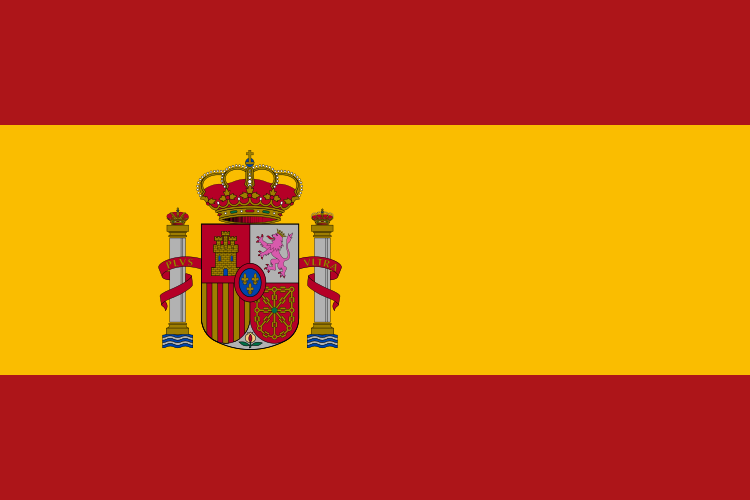
 ESP 16%
 FRA 12%
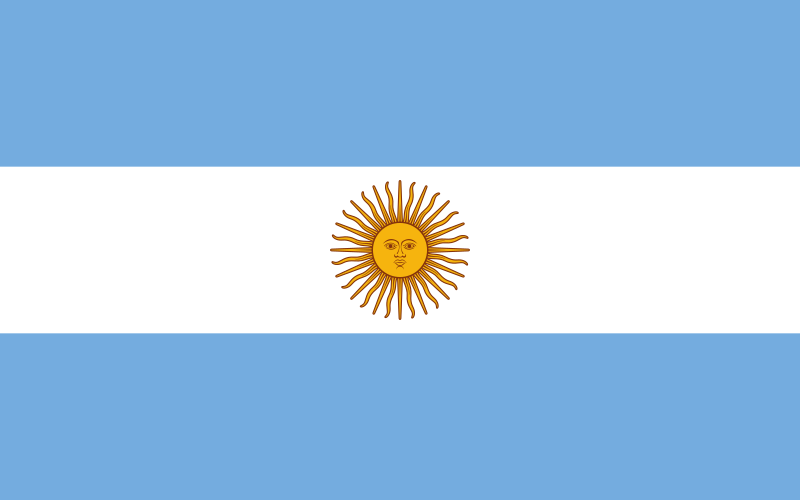 ARG 12%
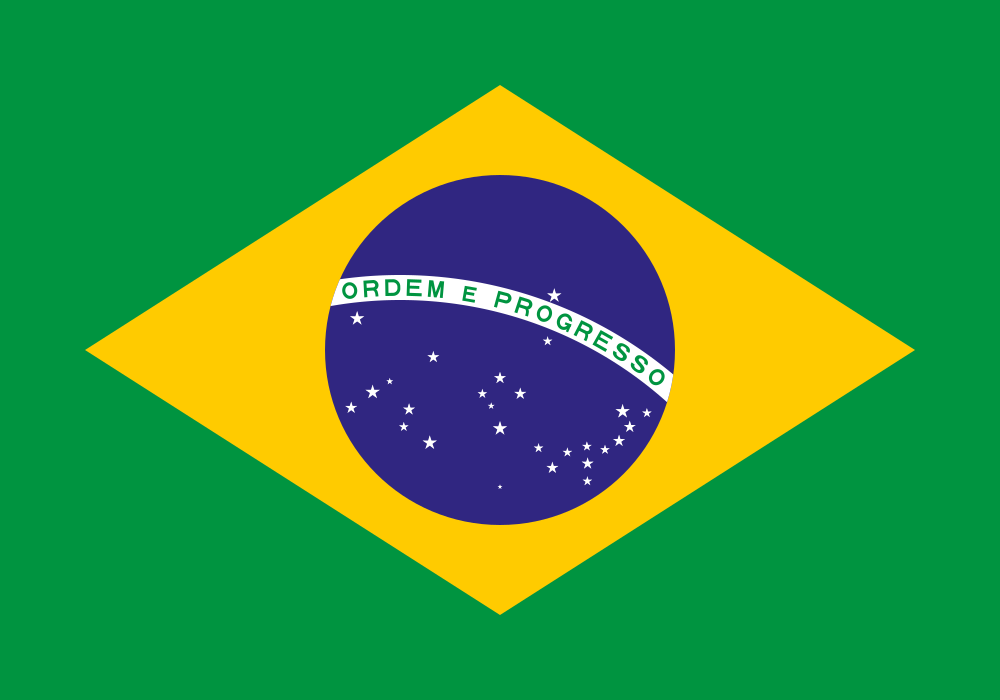 BRA 11%
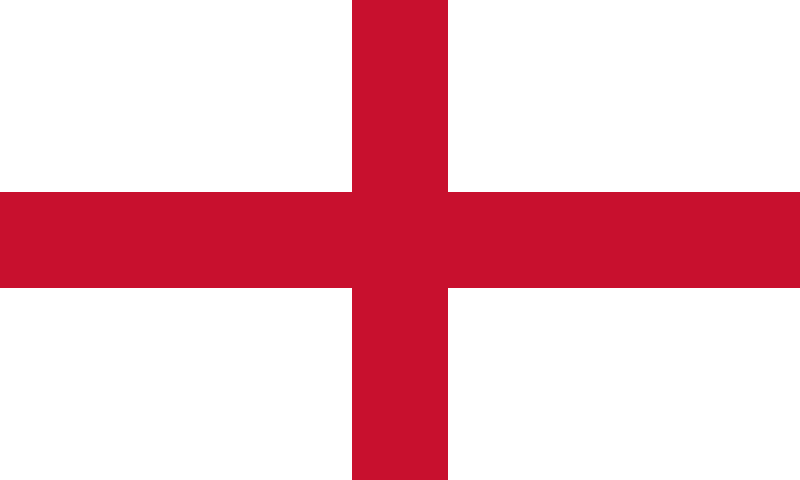 ENG 10%

With 104 matches and lopsided groups, a World Cup 2026 hat-trick is near-inevitable. Here is why the 'any hat-trick' Yes is underpriced and who delivers it.
The smart position on the 'Will Any Player Score a Hat-Trick at the World Cup' market is the Yes, and it is underpriced relative to how casual fans instinctively feel about it. A single player banging in three goals in one match sounds rare, but spread that question across 104 matches and 48 teams of wildly uneven quality and it stops being a long shot and starts looking close to a formality.
Most people anchor on the wrong reference point. They picture an elite knockout tie where defences are tight and one moment decides everything, and conclude a treble is a freak event. The reality of this tournament is the opposite: a month of group-stage football in which several of the world's deadliest finishers will line up against sides ranked outside the FIFA top 60, often with the game already won by the hour mark.
Add in penalty duty, set-piece prowess and the simple weight of numbers, and the structural case is strong. You do not even need to call the right player; you only need one of dozens of credible candidates to convert on one of more than a hundred occasions. That is why the market deserves a higher implied probability than gut feel suggests.
Ad
Why does a 48-team World Cup make a hat-trick more likely?
The maths changed the moment FIFA expanded the field. The old 32-team format delivered 64 matches; the 2026 edition runs to 104. That is over 60% more games, and crucially most of the extra fixtures are group-stage encounters where the talent gap between the elite and the rest is at its widest.
A bigger field also means more genuine minnows. Debutants and lower-ranked qualifiers are in the draw alongside Spain, France, Brazil and Argentina, and that produces fixtures with the kind of lopsided shape a hat-trick needs: a dominant favourite, a stretched defence, and a striker with the freedom to keep shooting. Blowouts are where trebles live.
There is a behavioural angle too. Coaches with a comfortable lead and a qualification spot in sight will often leave their main forward on the pitch rather than risk rotation, especially early in the group when goal difference can decide seeding into the round of 32. In an expanded format, goal difference matters more, which gives managers a reason to chase a fourth and fifth goal instead of shutting up shop.
Put simply, more matches multiplied by more mismatches multiplied by more incentive to keep scoring all point the same way. Each individual game is still a low-probability event for a hat-trick, but you are now compounding that probability across a far larger sample, and the cumulative chance of at least one treble climbs fast.
Which group-stage mismatches could produce a hat-trick?
The fixtures to circle are the ones where a top-tier attack meets a defence that simply cannot live with it. Spain, the Euro 2024 winners, share Group H with debutants Cape Verde and a Saudi Arabia side ranked outside the top 60, and a Lamine Yamal-led attack against either is the kind of game that can spiral. France and Norway both face Iraq in Group I, handing Kylian Mbappé and Erling Haaland a fixture tailor-made for a big personal tally.
Brazil open up against Haiti in Group C, a fixture with a vast ranking gap and a Vinícius Júnior-Rodrygo front line capable of running riot. Sweden's strike pair of Alexander Isak and Viktor Gyökeres meet Tunisia in Group F, and while the Carthage Eagles are disciplined, a single off day against that firepower is all it takes.
The chart below shows just how steep some of these mismatches are on FIFA ranking alone. These are the sides most likely to find themselves chasing shadows in a one-sided second half, and that is precisely the environment in which a striker piles up three.
None of this guarantees a specific scoreline, and you should not assume any result before it happens. But you do not need to. The point is that the schedule is stacked with exactly the type of fixture that has historically produced trebles, and there are several of them rather than one.
Which players are most likely to score the hat-trick?
Start with the volume scorers who also take penalties, because that is the cleanest route to three in a game: convert from the spot and you only need two from open play. Erling Haaland is the archetype, a relentless box finisher for Norway who will fancy a feast against Iraq, while Kylian Mbappé carries France's penalty duties and the pace to torment any tired defence.
Sweden offer a double threat that few sides can match, with Alexander Isak and Viktor Gyökeres both capable of a hot afternoon, and Dejan Kulusevski feeding them. England's Harry Kane is a perennial candidate given his penalty responsibilities and movement, and he has previous World Cup pedigree in this exact scenario.
Then there are the flair finishers who thrive in transition once a game opens up: Vinícius Júnior for Brazil, Lamine Yamal for Spain and, on the right night, Portugal's veteran finisher Cristiano Ronaldo. Any of these can turn a comfortable win into a personal showcase if the opposition fold.
The breadth of the candidate pool is the whole argument for the Yes. You are not trading your view on one man staying fit and firing; you are backing the field of a dozen or more elite finishers, any one of whom completing a single treble settles the market in your favour.
What do past World Cups tell us about hat-tricks?
Recent history is unambiguous. At the 2018 World Cup, Cristiano Ronaldo announced the tournament with a hat-trick against Spain, and Harry Kane added his own treble against Panama in the group stage. Two trebles, one tournament, in a 32-team format with only 64 games.
The 2022 edition repeated the trick. Gonçalo Ramos scored a hat-trick in the knockout rounds for Portugal, and Kylian Mbappé produced a hat-trick in the final itself. Again, multiple trebles across a smaller field than the one we are about to watch.
If a 32-team World Cup reliably produces at least one hat-trick, and usually more than one, then a 48-team World Cup with 40 extra matches and a longer tail of weaker sides should produce them at least as often. The historical base rate already favours the Yes before you layer on the expanded format.
Recency bias works in your favour here. Casual traders remember tight knockout games and underrate how routinely group-stage mismatches deliver. The data says trebles are a feature of the modern World Cup, not a rarity.
How should you price the 'any hat-trick' market?
Think in cumulative terms, not single-game terms. The right mental model is to ask how likely it is that zero hat-tricks are scored across 104 matches, then take the opposite of that. Once you frame the No as 'not a single one of these forwards manages three in any of more than a hundred games', it starts to look like the brave side of the trade.
Weight the early group games most heavily. Seeding and goal difference incentives mean favourites press for extra goals before the knockouts tighten things up, so the bulk of your probability is loaded into the opening fortnight rather than spread evenly.
Treat penalty duty as a genuine edge when you scan the candidates. A striker on spot-kicks effectively needs only two from open play, which materially shortens the path to a hat-trick and is exactly why Haaland, Mbappé and Kane sit at the top of the board.
If the live implied probability on the Yes looks anything short of strong, the structural case says it is cheap. This is a market where the format itself is doing the heavy lifting, and the casual instinct to fade a 'rare' event is the mispricing you want to take the other side of.
Where to trade the World Cup 2026 hat-trick market
You can trade the 'Will Any Player Score a Hat-Trick at the World Cup' market directly on Polymarket, and the structural argument above is the reason to get involved: 104 matches, a long tail of mismatches and a deep pool of elite finishers all point toward the Yes being underpriced versus casual instinct.
This is a prediction market, so the price moves with the news flow and with every goal that goes in. Treat any figure you see as a live snapshot rather than a fixed number, and check the current implied probability before you commit, especially once the group-stage mismatches throw up an early blowout.
New users have a clear reason to act now: Deposit $20, Get a $50 Trading Bonus with promo code TGSWC. That bonus gives you extra room to take a position on a market where the maths, the format and the history all line up on the same side.
Do your own read on the live price, weigh the candidates from Haaland to Mbappé to Sweden's strike pair, and trade the 'any hat-trick' market on Polymarket while the Yes still looks like value.
Frequently asked
Will any player score a hat-trick at the 2026 World Cup?
It is highly likely. Across 104 matches and a 48-team field packed with mismatches, at least one player has reached a hat-trick at every recent World Cup, so the 'Yes' is the smart read.
Who is most likely to score a hat-trick at World Cup 2026?
Erling Haaland and Kylian Mbappé head the list, with Sweden's Alexander Isak and Viktor Gyökeres, Brazil's Vinícius Júnior and England's Harry Kane all live candidates. Penalty takers facing weak defences are the prime profiles.
Why does a 48-team World Cup make a hat-trick more likely?
The expanded format means 104 games instead of 64 and more lopsided group fixtures against debutants and lower-ranked sides. More matches and bigger gaps in quality both push the probability of at least one treble higher.
Where can I trade the 'any hat-trick' market for World Cup 2026?
You can trade the 'Will Any Player Score a Hat-Trick' market on Polymarket. New users can currently deposit $20 and get a $50 trading bonus with promo code TGSWC, and the live price keeps moving so check it before you trade.
Has a hat-trick been scored at recent World Cups?
Yes. Cristiano Ronaldo and Harry Kane both scored trebles at the 2018 World Cup, and Gonçalo Ramos and Kylian Mbappé both managed it in 2022, underlining how regularly it happens.