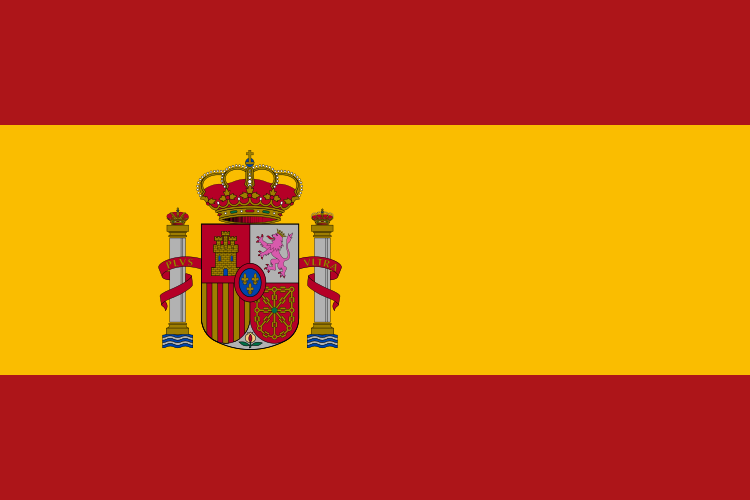
 ESP 16%
 FRA 12%
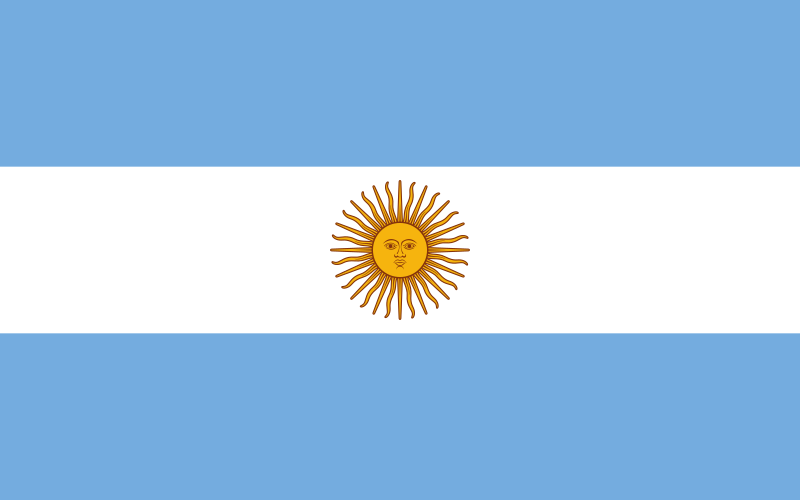 ARG 12%
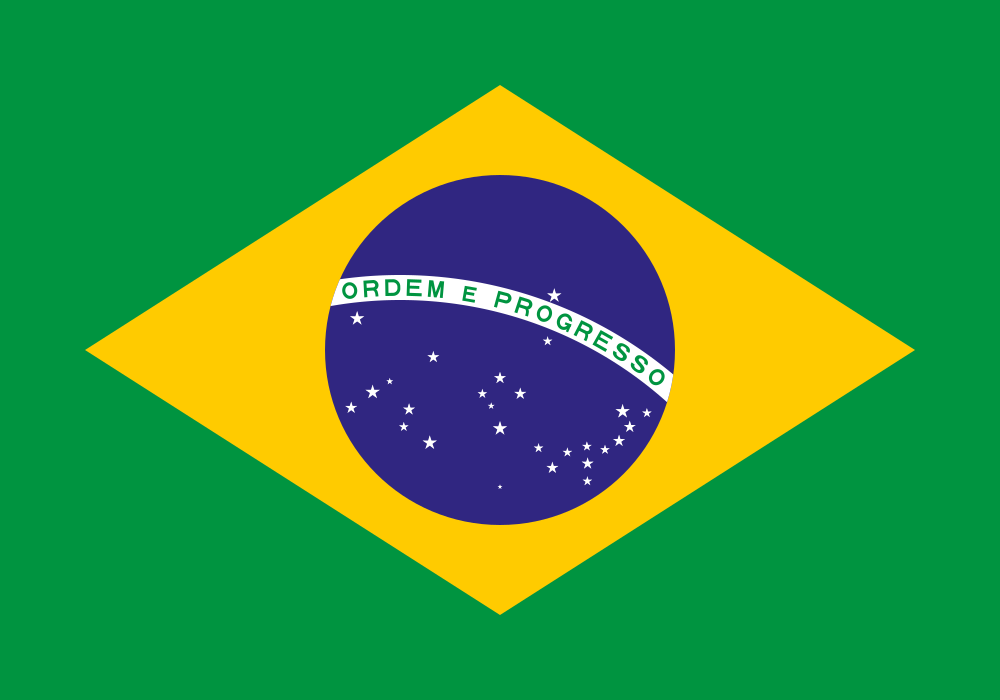 BRA 11%
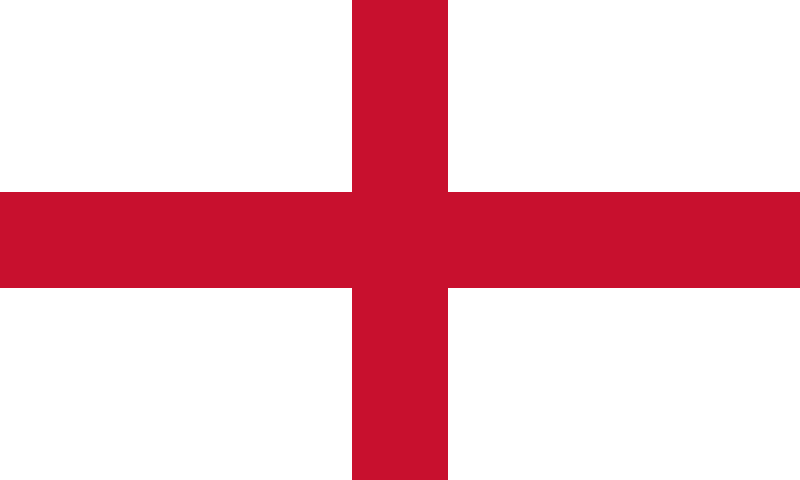 ENG 10%

Lionel Messi won the Polymarket Messi vs Ronaldo goals market, finishing on 8 as Argentina reached the final while Ronaldo's Portugal fell in the last 16.
Lionel Messi won the Messi versus Ronaldo goals market, and he won it comfortably: he closed World Cup 2026 on 8 goals, joint-second behind Kylian Mbappe's 10, while Cristiano Ronaldo did not even appear on the top-ten scorers list after Portugal were knocked out in the round of 16. If you priced this market on route to the latter rounds rather than raw finishing, you were on Messi the whole way, and the settle proved you right.
The reason to lead with the run and not the highlight reel is simple. This was never a pure shootout between two finishers on neutral ground. It was a race in which one man kept getting more matches, more minutes and more penalties than the other. Argentina marched to the final; Portugal went home after the last 16. Once that split opened up, the goals gap was almost a formality.
The smart way to have read this market from the start was to treat games remaining as the real currency. Finishing quality matters at the margin, but you cannot score in a tournament you have left. Messi's eventual 8 was built on volume as much as brilliance, and volume is exactly what a deep Argentina run guaranteed and an early Portugal exit destroyed.
Ad
Why did the depth of Argentina's run decide this market?
Argentina played eight matches at this World Cup: three in the group, then the round of 32, round of 16, quarter-final, semi-final and final. Portugal played five: three group games plus two knockout ties before Spain ended them 0-1. That is a three-game difference, and in a goals market three extra games is an enormous edge before either player takes a single shot.
Argentina topped Group J with a perfect nine points and a plus-seven goal difference, so Messi was involved in matches his side controlled and attacked. Portugal, by contrast, finished second in Group K behind Colombia, and their knockout path ran straight into Spain, the eventual champions, who shut them out. Losing that tie did not just cost Portugal a result; it capped Ronaldo's goal tally for good on the spot.
This is the core lesson for pricing any head-to-head goals market: model the fixtures, not the names. A striker on a semi-finalist has structurally more scoring runway than an equal striker on a team likely to exit in the last 16. The market that respected Argentina's superior seeding and deeper expected run was always going to lean Messi, and every round that Argentina survived widened the moat.
By the time Argentina reached the final against Spain, Ronaldo had been eliminated for weeks. The head-to-head was effectively settled long before the trophy was decided, which is exactly what a depth-of-run thesis predicts: the loser is locked in the moment his team loses, while the winner keeps banking chances.
How did penalty duty tilt the goals head-to-head?
Penalties are the quietest edge in a goals market and one of the most powerful. Messi is Argentina's designated taker, which means every foul in the box, every VAR review that goes his side's way, is a near-certain goal added to his column. Over eight matches that is a recurring stream of high-probability chances that no amount of open-play finishing can match for reliability.
Ronaldo carries the same penalty status for Portugal, so on a per-game basis the duty is roughly even. The difference, again, is games played. Messi had eight fixtures in which a spot-kick could be won; Ronaldo had five, and two of those were knockout ties Portugal were grinding through rather than dominating. More matches means more penalty exposure, and penalty exposure compounds a scorer's total.
For readers pricing this kind of market in future, treat penalty duty as a multiplier on games remaining, not a flat bonus. A designated taker on a finalist is worth far more than a designated taker on a team you expect to exit early, because the same conversion rate is applied across a much larger number of matches. Messi had both the role and the run, and the two stacked.
Where did Ronaldo's Portugal fall short?
Portugal were a genuinely strong squad on paper, but the tournament exposed the ceiling. They finished second in Group K, which sent them into a tougher knockout bracket, and while they saw off Croatia 2-1 in the round of 32, they ran into Spain in the last 16 and lost 0-1 without scoring. That single clean sheet against them ended Ronaldo's World Cup and froze his tally.
The lesson is that a striker's goals market lives and dies on his team's defensive resilience in one-goal knockout games as much as on his own shooting. Portugal could not break Spain down, and once they were out, Ronaldo had zero further games in which to close the gap on Messi. Compare that to Argentina, who survived a 1-1 quarter-final against Switzerland and edged England 2-1 in the semi to keep Messi on the pitch.
This is why fading Ronaldo in this specific market was the correct read even for those who rate him as a finisher. His farewell tournament was defined by an early, quiet exit rather than a deep run, and in a head-to-head goals contest the man who plays three more matches almost always wins regardless of who is sharper in front of goal on any given night.
Ronaldo the player was not the problem so much as Ronaldo's fixture list. Once Portugal exited, his number was final, and Messi simply kept adding to his.
What did Messi's role in Argentina's run add up to?
Messi's 8 goals put him behind only Mbappe's 10 and level with Erling Haaland and Jude Bellingham on 7 being just one back, comfortably clear of Ronaldo, who did not reach the four-goal threshold needed to make the published top-scorer list. In a two-horse market, that is not a photo finish; it is a rout, and it was authored by route and role.
As Argentina's talisman and penalty taker across eight matches, Messi occupied the one seat that maximised scoring output: a creative and finishing hub on a team that kept winning. Every extra round Argentina survived was another 90-plus minutes of shots, set-pieces and spot-kick chances funnelled through him, and the total climbed accordingly all the way to the final against Spain.
The chart below shows where Messi's 8 landed among the tournament's leading scorers. The tell is not just how high Messi finished; it is that Ronaldo does not feature at all, which is the whole market in one picture: the man on the finalist scored, the man on the eliminated side ran out of games.
For anyone still trading this market late, the takeaway held to the last whistle: back the deeper run, respect penalty duty, and let the fixture list do the heavy lifting.
Trade the Messi vs Ronaldo goals market on Polymarket
The Messi versus Ronaldo goals market is exactly the kind of head-to-head that rewards readers who think in fixtures rather than reputations, and World Cup 2026 proved the point: Messi's 8 goals and run to the final beat Ronaldo's early Portugal exit in a landslide. You can trade this market and every other World Cup 2026 prop on Polymarket, where the implied probability keeps moving with each result.
If you are new, the current offer is straightforward: Deposit $20, Get a $50 Trading Bonus with promo code TGSWC. That gives you the stake to take a position on the next head-to-head the moment the market opens, whether it is a Golden Boot race or the next superstar duel.
Always check the live price before you commit, because a prediction market reprices in real time as goals go in and teams advance. The edge in this market was never the finishing; it was reading the route first. Head to Polymarket, look at where the number sits now, and trade the side the fixture list backs.
Frequently asked
Who won the Messi vs Ronaldo goals market at World Cup 2026?
Lionel Messi won it. He finished the tournament on 8 goals, joint-second among all scorers, while Cristiano Ronaldo failed to reach the top-ten and went out with Portugal in the round of 16.
How many goals did Messi and Ronaldo score at the 2026 World Cup?
Messi scored 8, trailing only Kylian Mbappe's 10. Ronaldo did not make the published top-scorer list (which bottoms out at 4 goals), so his tally was well short of Messi's.
Why did Messi outscore Ronaldo?
The gap was mostly about route, not finishing. Argentina reached the final and played 8 matches, while Portugal were eliminated after 5, so Messi simply had far more games, minutes and penalties to score in.
Where can I trade the Messi vs Ronaldo goals market?
You can trade this market on Polymarket, where the price moves as each round is played. New users can Deposit $20, Get a $50 Trading Bonus with promo code TGSWC.