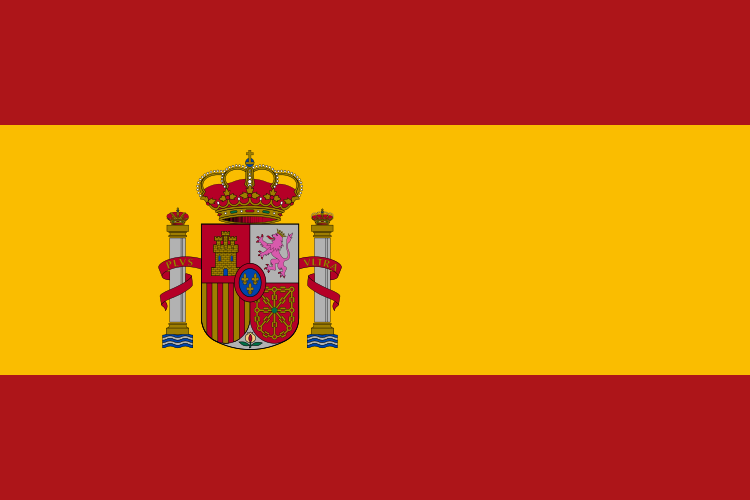
 ESP 16%
 FRA 12%
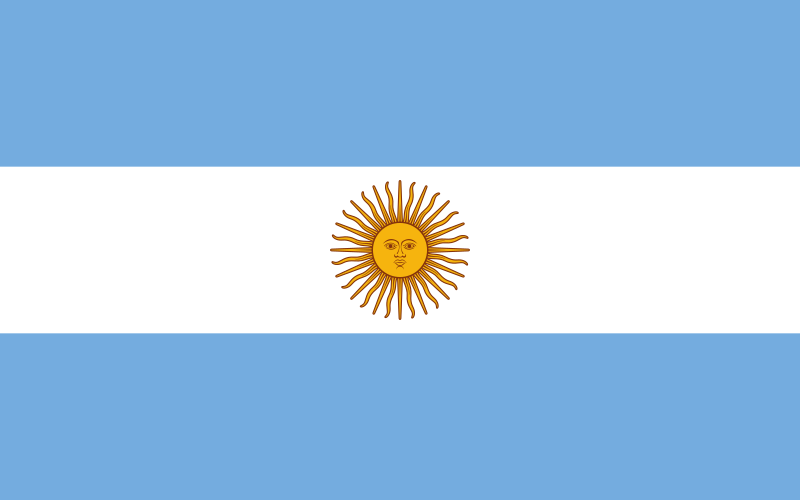 ARG 12%
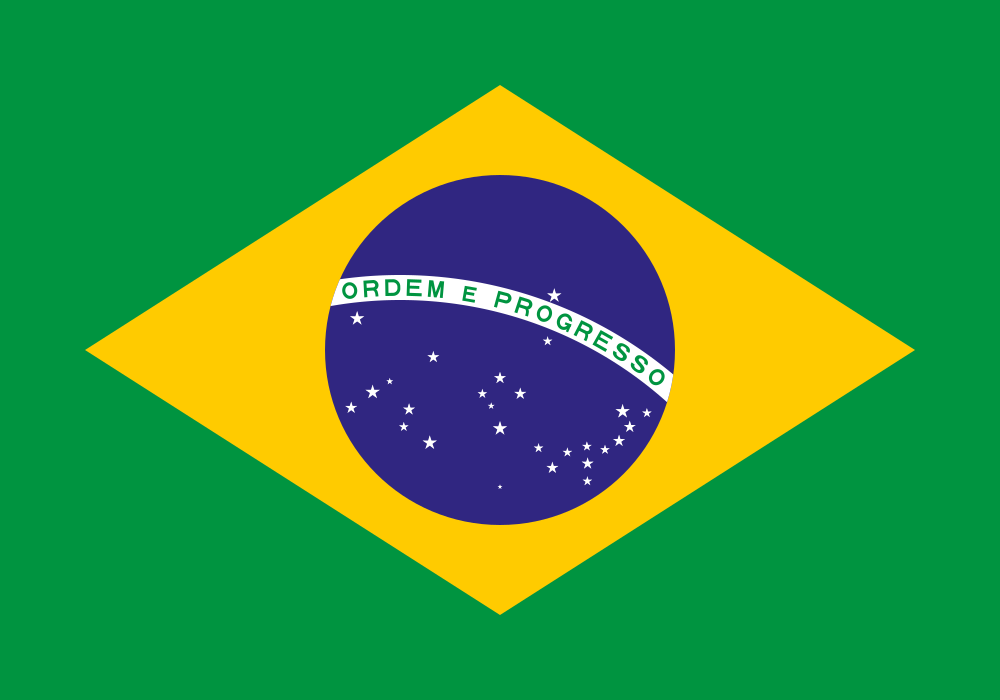 BRA 11%
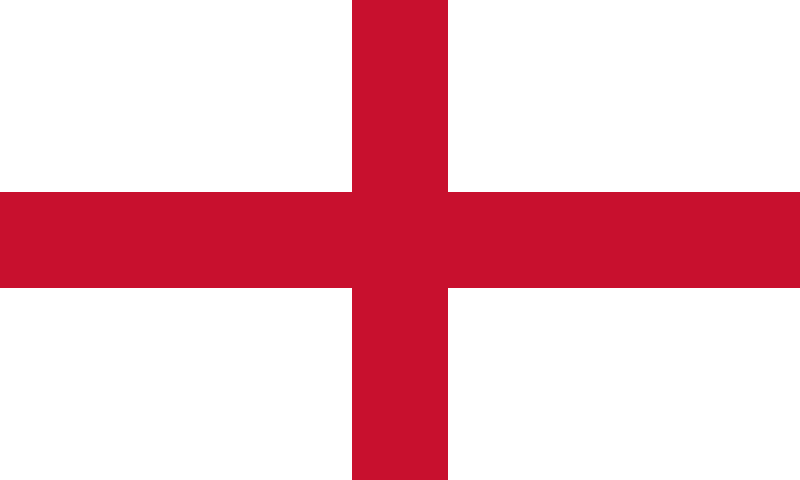 ENG 10%

The Messi vs Ronaldo goals market on Polymarket was a survival contest, not a finishing one. Messi's run to the final settled it: 8 goals to Ronaldo's few.
The verdict the whole tournament backed: the market should have favoured Lionel Messi in the Messi versus Ronaldo goals head-to-head, and it delivered emphatically. Messi finished on 8 World Cup 2026 goals as Argentina marched to the final, while Cristiano Ronaldo never troubled the top-scorer chart at all. The reason was not that Messi suddenly out-finished a rival he has shadowed for two decades. It was that this market was never really about finishing.
Read it correctly and this was a survival market wearing a finishing market's clothes. Goals are a function of two things: how well you convert, and how many games you get to convert in. The first was roughly a coin flip between two all-time greats in the twilight. The second was not close. Argentina's route pointed toward eight matches; Portugal's pointed toward an early exit. That asymmetry was the entire edge.
Anyone who priced this as 'who is the better striker right now' was answering the wrong question. The sharper read was 'whose team plays more football', and by that lens Messi was the pick long before a ball was kicked in the knockouts. The bracket beat the boot.
Ad
Why was the Messi vs Ronaldo goals market really a survival market?
Decompose any tournament scoring tally and you get goals-per-game multiplied by games-played. For two 30-something forwards whose per-game output has flattened, the first term barely separates them. The second term is where the market was won and lost, and it is almost entirely determined by the strength of the team around each man.
That is the trap in a market named after two individuals. The framing invites you to litigate finishing, sharpness and highlight reels, when the honest driver is your view on Argentina's and Portugal's respective ceilings. Argentina were a genuine title contender with a squad built to grind out knockout ties. Portugal, for all their talent, carried a transitional look and a soft underbelly in the biggest games.
The recency-bias pull was strong in the other direction. Ronaldo remains a magnet for goal-scoring narratives, and it is tempting to price a couple of early Portugal blowouts as evidence he would keep pace. But early-group goals are cheap; the goals that decide this market are the ones you only get to attempt if you are still in the tournament in July. Longevity, not sharpness, was the variable to underwrite.
The correct mental model was simple: back the player whose team you expect to play the most matches, unless the finishing gap is enormous. Here it was not. So you backed Messi and the deeper run.
How did Argentina's and Portugal's runs diverge?
The runs split exactly where the market said they would. Argentina topped their group with 9 points, then survived a Round-of-32 scare against Cape Verde on penalties, beat Egypt 3-2, edged Switzerland in the quarter-final and downed England in the semi before losing a goalless final to Spain on penalties. That is eight matches, eight windows for Messi to add to his tally, and he took them to the tune of 8 goals.
Portugal's tournament was half as long. They came second in their group behind Colombia, saw off Croatia 2-1 in the Round of 32, and then ran into Spain and lost 0-1 in the Round of 16. Five games, then home. Ronaldo simply ran out of tournament, and with it ran out of chances to score. He never reached the top-scorer chart, which ran all the way down to four goals, so his final tally sat at three at most.
That is the whole story in one line: eight games to five. Even if you had handed Ronaldo an identical per-game scoring rate to Messi, the extra three matches would still have tipped the head-to-head. The finishing was a sideshow; the calendar did the heavy lifting.
The scoring chart underlines how far ahead Messi finished. His 8 goals put him second only to Kylian Mbappé across the entire tournament, level with Erling Haaland and Jude Bellingham, and streets clear of a rival who never made the list.
Did penalty duties and roles tilt it further toward Messi?
Once you accept that games-played was the main lever, the secondary levers all pointed the same way. Messi remained the on-field hub of Argentina's attack, the man the whole shape funnels through, and Argentina's designated penalty taker. In a tournament where his side went to two shootouts and repeatedly won tight knockout ties, that central role kept his hands on every source of goals, from open play to spot-kicks to free-kicks.
Ronaldo's role had drifted the other way. Portugal increasingly built around younger legs, and their talisman became a penalty-box finisher dependent on service rather than a creator generating his own volume. When the service dried up against Spain, so did his tournament. A peripheral striker on a team that exits early is the worst possible profile for a goals market.
Penalty duty is the quiet multiplier here. A guaranteed taker on a team that keeps reaching shootouts and late-game pressure banks conversions that a marginal forward never gets near. Argentina's habit of surviving on penalties did not just extend Messi's run; it repeatedly put the ball on the spot in front of him.
So the two men were not even competing on the same terms. Messi had the deeper run, the central role and the penalty, while Ronaldo had a shorter run, a narrower role and no such safety net. Stack those and the head-to-head was lopsided long before the final tally confirmed it.
What should traders take from how this market resolved?
The lesson is portable to every player-versus-player market on the board: price the route before you price the talent. When two comparable scorers are pitted against each other, the edge usually lives in the bracket, the group draw and the team's knockout ceiling, not in who looks sharper in a highlight package. Ask which team plays more games, and you are most of the way to the answer.
Beware the narrative pull of a big name in decline. Ronaldo's brand keeps his goal markets liquid and tempts traders into overpaying for a finish that the fixtures may never allow. The disciplined move was to fade the story and back the structure: Argentina's superior squad depth made Messi the higher-floor, higher-ceiling option in the same trade.
It is also a reminder that early-round goals flatter and mislead. A forward can look like he is winning this market after the group stage and still lose it decisively because his team goes out in the Round of 16. Weight the goals that require survival more heavily than the ones scored against overmatched group opponents.
Underwrite longevity, respect penalty duty, and treat the deeper run as the real asset. That framework had Messi as the call, and the tournament paid it out in full.
Where can you trade the Messi vs Ronaldo market on Polymarket?
This market lived on Polymarket, the prediction market where you trade the implied probability rather than back a fixed price, and the whole World Cup 2026 board is there alongside it: Golden Boot, top-scoring nation, Golden Ball and every player head-to-head. Prices move with every match, so the live number is always the one to check before you commit.
Because these are traded markets, implied probabilities drift constantly on team results, injuries and momentum. That is exactly why a route-first read pays: when the crowd overweights a famous finisher and underweights his team's exit risk, the mispricing sits there for anyone willing to trade the structure rather than the name.
If you want in on the next edition of these player duels, Polymarket is the venue. New users can use promo code TGSWC for the current offer: Deposit $20, Get a $50 Trading Bonus. Fund the account, find the head-to-head, and trade the live price while it is still moving.
Frequently asked
Who scored more at the 2026 World Cup, Messi or Ronaldo?
Lionel Messi scored more, finishing the tournament on 8 goals as Argentina reached the final. Cristiano Ronaldo did not appear on the top-scorer chart, which bottomed out at four goals, so he ended with at most three.
Why did Messi win the goals head-to-head?
Argentina went all the way to the final, handing Messi eight matches of chances, while Portugal were knocked out in the Round of 16 after just five games. Depth of run, not finishing quality, was the decisive variable.
How many goals did Messi score at World Cup 2026?
Messi scored 8 goals, the second-highest tally of the tournament behind Kylian Mbappé's 10 and level with Erling Haaland and Jude Bellingham on the scoring chart.
Where can I trade the Messi vs Ronaldo goals market on Polymarket?
You can trade this market and the rest of the World Cup 2026 board on Polymarket. New users can use promo code TGSWC for the current offer: Deposit $20, Get a $50 Trading Bonus.