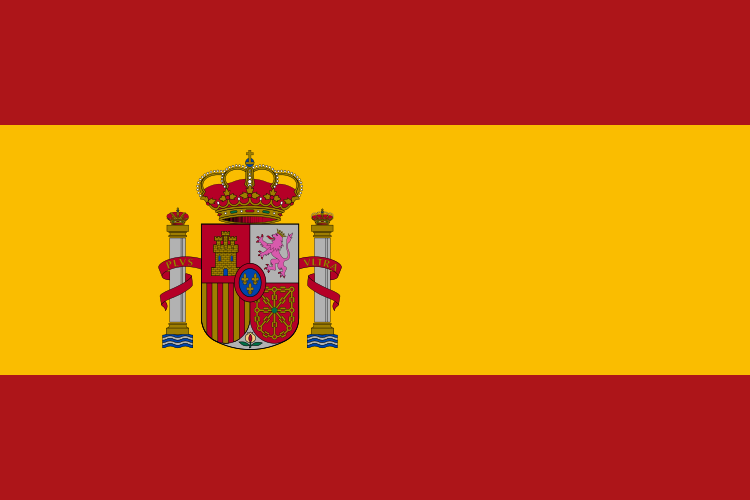
 ESP 16%
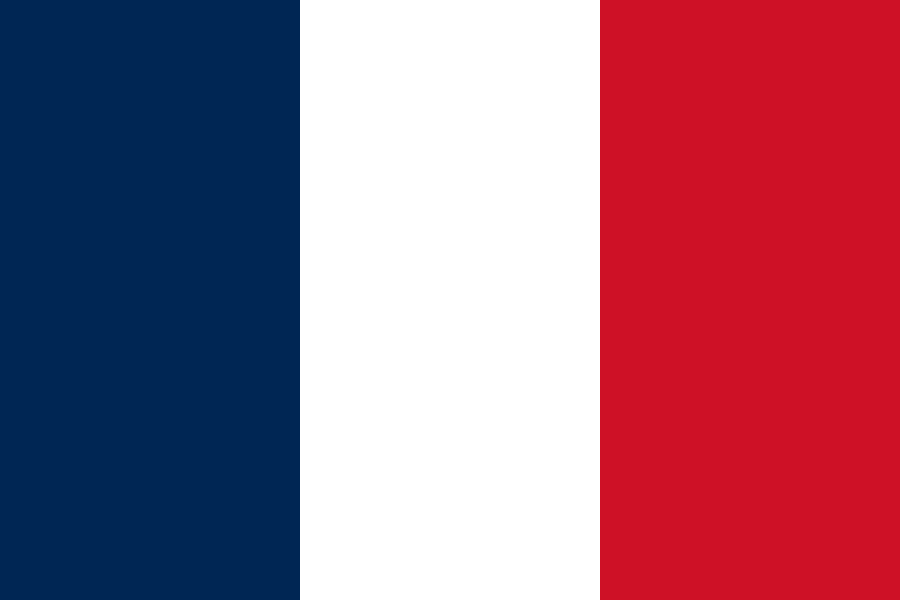 FRA 12%
 ARG 12%
 BRA 11%
 ENG 10%
The 2026 World Cup knockouts mixed chaos and order: the four top FIFA-ranked teams all reached the semis, and Spain met Argentina in a goalless final.
The single clearest lesson of the World Cup 2026 knockouts is that seeding held at the very top even as it collapsed everywhere else. The four teams that reached the semi-finals, France, Spain, Argentina and England, are the four highest-ranked sides in the world: FIFA numbers 1, 2, 3 and 4 respectively. For all the shootouts and shocks lower down the bracket, the last four was pure chalk.
From there, Spain and Argentina came through the semis, Spain beating France 2-0 and Argentina edging England 2-1, to contest a final that finished 0-0. England took third place, beating France 6-4 in a remarkable play-off. The destination of the trophy was decided between the world's second and third-ranked nations, exactly where the pre-tournament markets pointed.
What makes that outcome striking is the carnage that preceded it. Germany, the Netherlands and Brazil were all gone by the round of 16, penalty shootouts settled a string of ties, and the highest-ranked side to miss the semis was Brazil at FIFA #6. Below the summit, this was one of the most chaotic knockout stages in memory; at the summit, order reigned.
Ad
Why did the top four seeds all reach the semis?
The headline pattern of these knockouts is almost too neat: France (FIFA #1), Spain (#2), Argentina (#3) and England (#4) occupied all four semi-final berths. It is rare for the world's top four ranked teams to converge on the final weekend, and it happened here despite a bracket littered with upsets.
The title odds told the same story before a ball was kicked. Spain led the market at 16%, with France and Argentina both at 12% and England at 10%. Those four were among the five shortest-priced teams in the field, and four of the five delivered. The only pre-tournament heavyweight to fall short of expectations at the summit was Brazil, whose 11% did not survive the round of 16.
The lesson for anyone reading the knockout results is that depth and pedigree still travel furthest over a seven-game gauntlet. Underdogs can win a tie, sometimes two, on emotion and a hot goalkeeper, but stringing four knockout wins together demanded the squad quality only the elite possessed. Spain's 2-0 dismissal of France and 2-1 win over Belgium showed a side able to raise its level against fellow contenders, not just grind past minnows.
Which giants crashed out, and how?
The knockouts were brutal on the pre-tournament contenders who fell just short of that elite tier. Germany, ranked #10 and priced at 8%, lasted only until the round of 32, drawing 1-1 with Paraguay and losing 4-3 on penalties. The Netherlands (#7, 6%) went the same way in the same round, held 1-1 by Morocco and beaten 3-2 in the shootout.
Brazil's exit was arguably the biggest of the lot. Ancelotti's Seleção, second favourites at 11%, beat Japan 2-1 in the round of 32 but were then dumped out 2-1 by Norway in the round of 16. Portugal, in what was billed as Ronaldo's farewell, edged Croatia 2-1 before running into Spain and losing 1-0. Belgium reached the last eight, beating Senegal and thrashing the United States 4-1, before Spain ended their run 2-1.
The through-line is that being good was not enough; you had to be ruthless in the fine moments. Germany and the Netherlands both created enough to win in normal time and instead surrendered to spot-kicks. Brazil conceded twice to a Norway side ranked 25 places below them. The margin between a deep run and an early flight home was measured in single goals and single penalties.
Did penalties decide the knockout stage?
More than any recent World Cup, the 2026 knockouts turned on penalty shootouts. In the round of 32 alone, Paraguay knocked out Germany 4-3 on penalties, Morocco beat the Netherlands 3-2, and Egypt eliminated Australia 4-2 after a 1-1 draw. Each was a heavyweight or fancied side undone once the game went to the spot.
The shootout theme carried deep into the bracket. Switzerland beat Colombia 4-3 on penalties in the round of 16 after a goalless 90 minutes, then reached the semi-final conversation by pushing Argentina to the limit in a 1-1 quarter-final. England likewise advanced from a 1-1 quarter-final with Norway. Ties that once separated the elite from the pack were increasingly settled by nerve rather than dominance.
For the analysts, the takeaway is that shootout preparation is now a core competency, not a lottery excuse. Switzerland built an entire quarter-final run on defensive control and composure from 12 yards, the profile of a #19 side that maximised every fine margin. Teams that treated penalties as chance rather than skill, Germany and the Netherlands among them, paid for it.
How far did the dark horses actually run?
The overachievers gave the tournament its texture, but the knockouts also drew a firm ceiling under them: the quarter-finals. Norway, ranked #31 and a 2% shot, produced the run of their generation, beating Ivory Coast 2-1, stunning Brazil 2-1 and reaching the last eight before losing to England. Haaland's seven goals made him the tournament's third-highest scorer.
Morocco confirmed their 2022 semi-final was no fluke, dispatching the Netherlands on penalties and Canada 3-0 before France ended their run 2-0 in the quarter-finals. Switzerland ground their way to the same stage on defence and shootouts. Further down, Cape Verde (#69) and Senegal both bowed out in the round of 32 on penalties, while Cape Verde's debut and Senegal's exit from the Group of Death gave the early rounds their romance.
The pattern is consistent: outsiders could win one or two knockout ties, but none breached the semi-finals. The last four belonged exclusively to the top four ranked nations. For all the noise about a wide-open era, the 2026 knockouts suggest the gap between the elite and the merely very good is real, and it widens with every additional round.
What did the co-hosts and the goalscorers reveal?
Home advantage carried all three co-hosts into the knockouts but no further than the round of 16. Mexico won Group A convincingly and beat Ecuador 2-0 before losing a 3-2 thriller to England. The United States topped Group D and edged Bosnia and Herzegovina 2-0, only to be overwhelmed 4-1 by Belgium. Canada beat South Africa 1-0 before Morocco ended their tournament 3-0. A shared last-16 exit was a solid return, but the deep home run never materialised.
The scoring charts tell their own cautionary tale about star power versus silverware. Mbappé's 10 goals topped the lot, yet France finished fourth. Haaland's seven could not lift Norway past the last eight, and Jude Bellingham (7) and Harry Kane (6) fell with England in the semis. Individual brilliance drove teams a long way; it did not, on its own, deliver the final.
The finalists offered the counterpoint. Messi's eight goals were spread through a balanced Argentina side, and Spain reached the final leaning on Mikel Oyarzabal's five and a defence that conceded sparingly in the knockouts, keeping France scoreless in the semi and Argentina out in the goalless final. The message from the numbers is that spread and structure outlasted single-name dependence.
What is the overall verdict on the 2026 knockouts?
Boiled down, the 2026 knockout stage taught three things. First, the elite tier is genuinely separated from the rest: the four best-ranked teams in the world filled the semi-finals, and no outsider crossed that line. Second, the middle class of contenders, Germany, the Netherlands, Brazil and Portugal, was thinner than its reputation and repeatedly undone by fine margins and shootouts. Third, romance is real but finite, with Norway, Morocco, Switzerland, Cape Verde and Senegal all lighting up the bracket without breaking into the last four.
The finalists embodied the winning formula. Spain and Argentina, the world's #2 and #3, combined pedigree with defensive control and got to a 0-0 final without relying on a single hot streak. Both had navigated jeopardy, Argentina through 1-1 quarter-final tension with Switzerland, Spain by beating Belgium and France, and both answered it.
For readers tracking where the game is heading, the knockouts suggest depth, nerve from the spot and defensive solidity now decide tournaments as much as attacking talent does. The bracket delivered chaos and heartbreak in abundance, yet when the dust settled it was the most predictable teams of all standing on the final weekend.
Frequently asked
Which teams reached the World Cup 2026 semi-finals?
France, Spain, Argentina and England reached the semi-finals. Remarkably, they are the four highest-ranked teams in the FIFA world rankings (numbers 1 to 4).
How did Germany get knocked out of World Cup 2026?
Germany exited in the round of 32, drawing 1-1 with Paraguay before losing 4-3 on penalties. It was the earliest of the tournament's marquee eliminations.
Did any underdogs reach the World Cup 2026 quarter-finals?
Yes. Norway (FIFA #31), Switzerland (#19) and Morocco (#8) all reached the last eight, with Norway knocking out Brazil and Morocco beating both the Netherlands and Canada along the way.
Who was the top scorer across World Cup 2026?
Kylian Mbappé of France finished as top scorer with 10 goals, ahead of Argentina's Lionel Messi on 8 and Norway's Erling Haaland on 7.
How did Brazil exit World Cup 2026?
Brazil beat Japan 2-1 in the round of 32 but were then eliminated 2-1 by Norway in the round of 16, one of the knockout stage's biggest shocks.