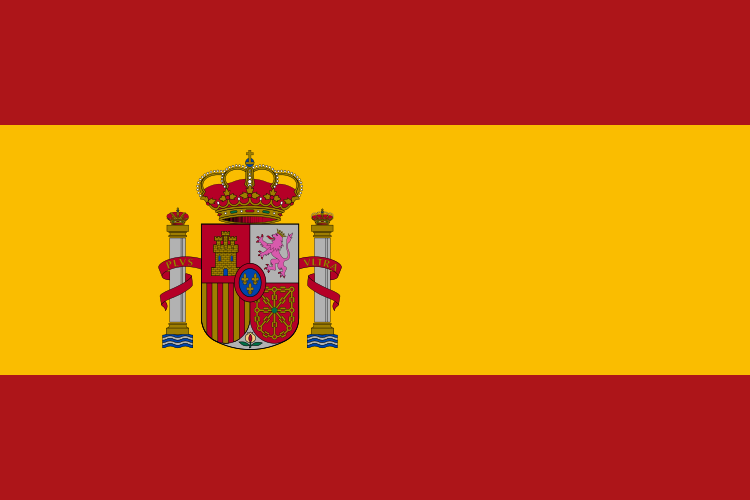
 ESP 16%
 FRA 12%
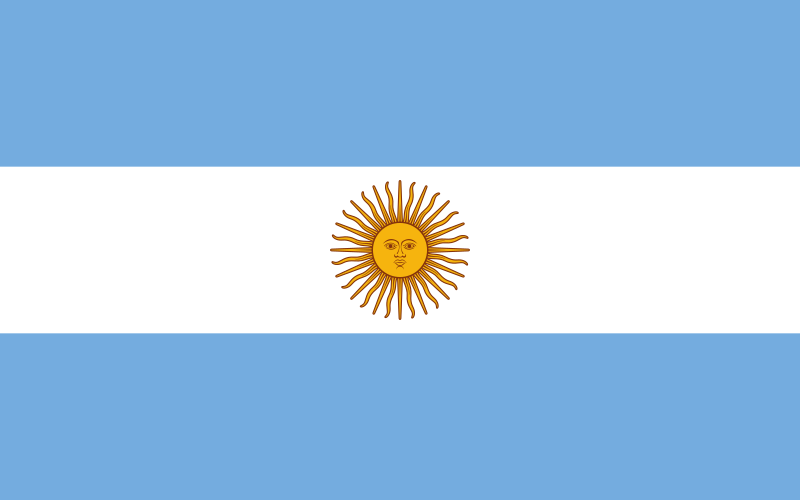 ARG 12%
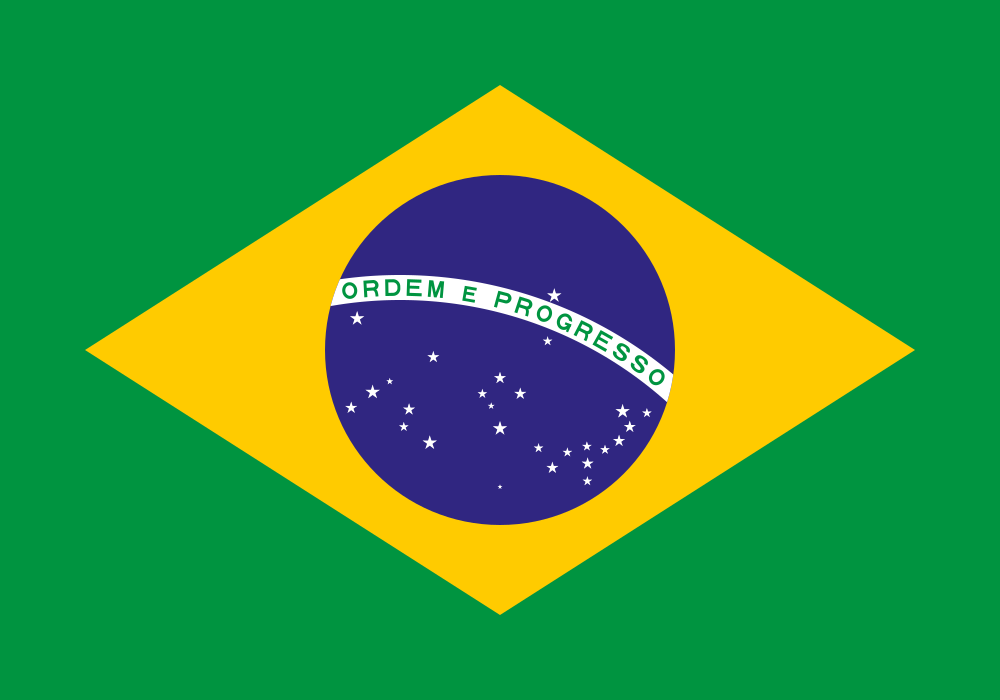 BRA 11%
 ENG 10%

The Messi vs Ronaldo goals market resolved emphatically for Lionel Messi: eight goals across eight games to the final, while Ronaldo's Portugal fell in the last 16.
The Messi vs Ronaldo goals market was never really a finishing contest, and the final results prove it: Lionel Messi won it in a canter, ending World Cup 2026 on eight goals while Cristiano Ronaldo failed to break into the top-ten scorers. The verdict was written by the bracket, not the boot.
The smart read all along was that this head-to-head would be decided by depth of run rather than raw quality of striking. Argentina marched to the final and played eight matches; Portugal were gone after five, beaten 1-0 by Spain in the round of 16. Once the draw separated the two, Messi had double-digit extra minutes of tournament football and a steady supply of chances that Ronaldo's early exit simply denied him.
This is a retrospective on a market that has now settled, and the lesson is a clean one for future editions: when two veterans are pitted goal-for-goal, price the run first and the finishing second.
Ad
How far did Argentina and Portugal actually go?
Argentina won Group J with a perfect nine points and a plus-seven goal difference, then ground through a brutal knockout gauntlet. They edged Cape Verde on penalties after a 1-1 draw, beat Egypt 3-2, saw off Switzerland on penalties following a 1-1 quarter-final, and downed England 2-1 in the semi. Only a goalless final against Spain, lost on penalties, halted them. That is eight matches of football.
Portugal, by contrast, finished second in Group K behind Colombia on five points. They saw off Croatia 2-1 in the round of 32, then ran into Spain and lost 1-0. Five matches, and the last of them was a chastening reminder that this Portugal side could not live with the tournament's best. Ronaldo's farewell ended quietly in the last 16.
The gulf in longevity is the whole story. Argentina played three more games than Portugal, three more chances for their talisman to score, three more sets of penalties and set-pieces to fall his way. No amount of finishing quality from Ronaldo could have bridged a three-match deficit in opportunity.
Why did the length of run decide Messi vs Ronaldo?
Goals are a volume game before they are a quality game. A striker who plays eight matches will, on average, out-score an equal striker who plays five, even if the latter is marginally sharper in front of goal. That base-rate truth is what a sharp trader should have leaned on the instant Argentina and Portugal landed on divergent halves of the draw.
Messi converted that volume into a genuine haul. His eight goals left him second only to Mbappé's ten and ahead of Haaland and Bellingham on seven apiece. Spread across a run to the final, that is roughly a goal a game, exactly the return you would model for a player getting the most touches in the most matches.
Ronaldo never got the runway. Portugal's exit capped his ceiling at five games, and with it any realistic path to overhauling Messi. The market that priced this as a finishing shootout misread the assignment: this was always a survival-of-the-team wager dressed up as an individual duel.
Penalty duties and roles: who owned the goal threat?
Role mattered as much as run. Messi remained the fulcrum of everything Argentina did going forward, taking the free-kicks, occupying the penalty spot and dropping into the pockets where chances are manufactured. On a team built to funnel the ball through him, every extra game meant a guaranteed stream of high-value touches.
That centrality showed up in the shootouts too. Argentina won two of them, against Cape Verde and Switzerland, and Messi's status as the designated taker kept him at the heart of the decisive moments even when open play stayed tight. Shootout conversions do not swell a Golden Boot tally, but the point is the role: he was never a passenger.
Ronaldo's role had narrowed. Portugal leaned on Bruno Fernandes and Vitinha to create, and their sharpest work came in midfield rather than through a focal-point number nine. In a five-game cameo, an isolated finisher needs service and a long run to accumulate goals. Ronaldo got neither, and the market that clung to his name over his situation paid for it.
What the scoring charts actually showed
The final scoring table is the cleanest evidence. Messi's eight goals sat him firmly among the tournament's elite finishers, comfortably clear of the pack chasing Mbappé. Ronaldo does not appear on the list at all, which places him below the joint-tenth mark of four goals.
Set the two side by side and the market's resolution is obvious. Messi did not merely win the duel; he lapped it, out-scoring Ronaldo by a margin wide enough that Portugal's early exit was almost incidental to the final numbers.
This is why a chart of the tournament's leading scorers, not pre-tournament reputation, was the tool a reader needed. The names at the top were decided by who kept playing and who kept getting chances, and Messi ticked both boxes.
What should the market have priced?
A disciplined trader should have shaded heavily toward Messi the moment Argentina looked like a genuine finalist and Portugal like a mid-tier knockout side. The correct mental model was not "who is the better finisher at 38" but "whose team plays more football, and who is more central to his team's goals". On both counts, Messi was the answer.
The trap was recency and reputation: Ronaldo's name still commands attention, and any market pairing him with Messi will attract support out of loyalty rather than logic. That is precisely the kind of soft money that creates value on the other side. Fading the sentiment and backing the deeper run was the edge.
The broader takeaway for future duels of this type is simple. When a player-versus-player goals market hinges on two different teams, treat it first as a bracket question. Depth of run sets the ceiling; finishing form only decides things at the margins. Messi vs Ronaldo 2026 was the textbook case.
Trade the next market on Polymarket
This particular head-to-head has now resolved for Messi, but the World Cup 2026 board on Polymarket is packed with markets that turn on exactly the same logic: run length, role and volume rather than reputation. If you learned anything from watching this one settle, the next edge is already waiting to be priced.
Polymarket is a prediction market, so you are trading against other people's reads of the probability, and those implied odds keep moving. That is where the value lives: when the crowd anchors to a famous name over a favourable situation, the smart side is on offer. Check the live price before you commit, because the number you see now will not be the number at kickoff.
New to the platform? There is a live offer for readers: Deposit $20, Get a $50 Trading Bonus with promo code TGSWC. Head to Polymarket, load up the World Cup 2026 markets, and put the run-decides-it lesson to work on the next duel.
Frequently asked
Who won the Messi vs Ronaldo goals market at World Cup 2026?
Lionel Messi won it comfortably. He finished the tournament with eight goals, second only to Kylian Mbappé's ten, while Cristiano Ronaldo did not make the top-ten scorers list. Argentina reaching the final while Portugal exited in the last 16 settled the head-to-head.
Why did the length of each team's run matter so much?
Because goals need games. Argentina played eight matches to the final and Portugal only five before Spain knocked them out, so Messi simply had far more opportunities to add to his tally than Ronaldo ever got.
How many goals did Messi score at the 2026 World Cup?
Messi finished on eight goals, ranking him second in the tournament behind Mbappé's ten. That total also put him ahead of Erling Haaland and Jude Bellingham, who each ended on seven.
How far did Ronaldo's Portugal go?
Portugal finished second in Group K, beat Croatia 2-1 in the round of 32, then lost 1-0 to Spain in the round of 16. That last-16 exit ended Ronaldo's tournament after just five matches.
Where can I trade markets like Messi vs Ronaldo goals?
You can trade this and every other World Cup 2026 prediction market on Polymarket, where implied probabilities move in real time. New users can deposit $20 and get a $50 trading bonus with promo code TGSWC.