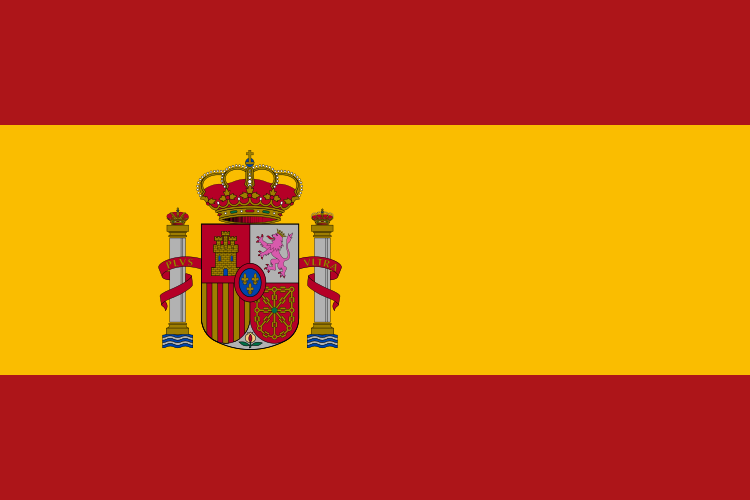
 ESP 16%
 FRA 12%
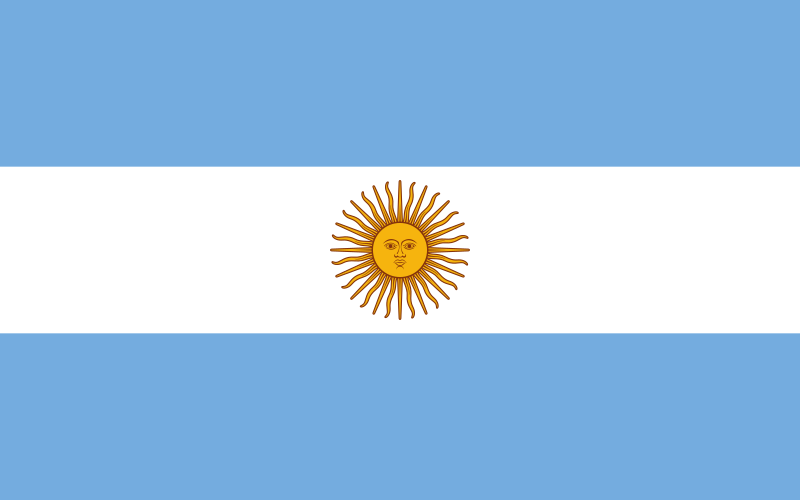 ARG 12%
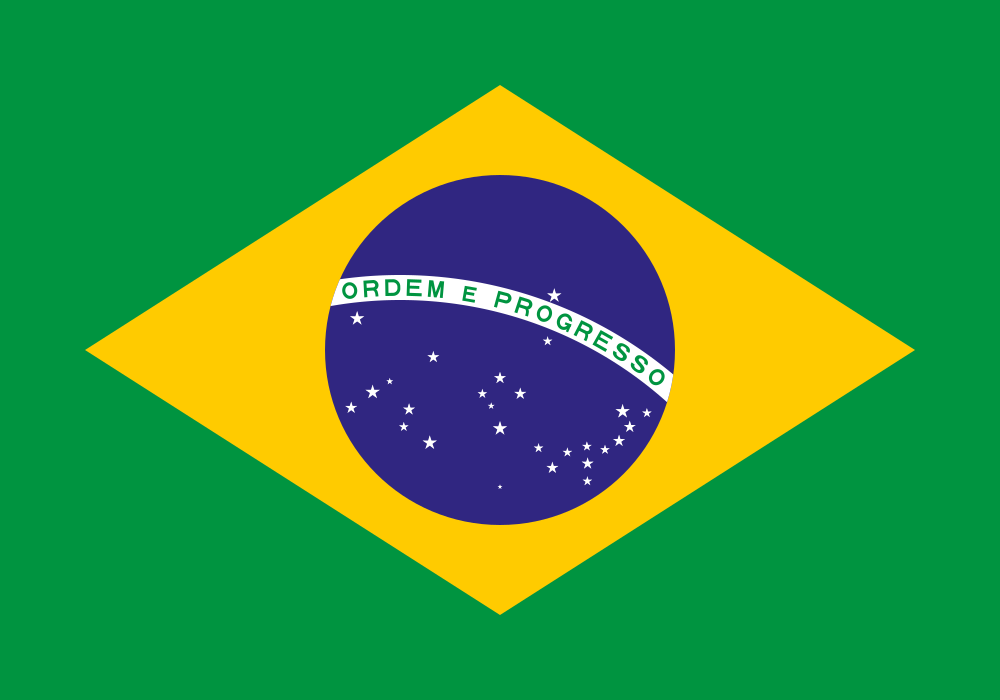 BRA 11%
 ENG 10%

Mbappé tops the World Cup 2026 scoring charts on 10 goals, winning the Golden Boot ahead of Messi (8), with Haaland and Bellingham tied on 7 each.
Kylian Mbappé leads the World Cup 2026 scoring charts on 10 goals and has won the Golden Boot. With the tournament complete, no one got close enough to overhaul him: France's captain finished a full four goals clear of runner-up Lionel Messi (8), with Erling Haaland and Jude Bellingham sharing third on 7 apiece.
That final margin tells its own story. Mbappé did not just win the Golden Boot; he dominated it, reaching double figures in a 48-team field where only three other players even cleared six goals. The race many expected to go to the wire was effectively settled well before the closing rounds.
What makes the leaderboard fascinating is not the winner but the company around him. The men who filled out the top of the charts came overwhelmingly from teams that fell short, and the two scorers who actually reached the final, Messi and Spain's Mikel Oyarzabal, sit second and seventh. Here is how the scoring charts finished and what they reveal.
Ad
Who leads the World Cup 2026 scoring charts?
The order at the top is clear. Mbappé's 10 is the standout number, ahead of Messi on 8, then Haaland and Bellingham locked together on 7. France's Ousmane Dembélé and England's Harry Kane follow on 6, with Oyarzabal on 5 rounding out the players who hit the mid-single digits.
Behind them, a cluster of four-goal scorers closes the top 10: Mexico's Julián Quiñones, Brazil's Vinícius Júnior and Senegal's Ismaïla Sarr. It is a notably top-heavy chart. The gap between Mbappé and the chasing pack is wider than the gap spanning positions two through six, which underlines how much daylight the Frenchman created.
The spread of names is a reminder that goals at this World Cup were not the preserve of the eventual finalists. Four different confederations are represented in the top 10, with CONMEBOL (Messi, Vinícius), UEFA (Mbappé, Haaland, Bellingham, Dembélé, Kane, Oyarzabal), CONCACAF (Quiñones) and CAF (Sarr) all putting a marksman on the board.
For all the talk of tournament football tightening up and chances drying out in the knockouts, the elite forwards still delivered. Six of the top 10 scored at least five times, a healthy return in a competition where defences are drilled and margins are fine.
Why did the top scorers come from fallen giants?
The most striking feature of the charts is how many of the heavy scorers watched the final from home. Mbappé's France were beaten 0-2 by Spain in the semi-final and then lost the third-place match 4-6 to England. Bellingham and Kane's England reached that same last four before falling 1-2 to Argentina. Haaland's Norway ran out of road in the quarter-finals, losing 1-1 to England and going out there.
The pattern runs deeper down the list. Vinícius Júnior's Brazil were stunned 1-2 by Norway in the round of 16, Quiñones and Mexico lost 2-3 to England at the same stage, and Sarr's Senegal exited in the round of 32, beaten by Belgium. In other words, the bulk of the firepower on this leaderboard belonged to sides that were knocked out, in several cases earlier than their pedigree suggested.
That is partly a quirk of format: a prolific forward on an eliminated team simply has more games to accumulate goals if his side goes deep, and France and England both went deep before falling at the last-four stage. But it also reflects how this World Cup punished even goal-laden teams. Scoring freely was no guarantee of survival when the knockouts turned on fine margins and penalties.
The exceptions are telling. Only Messi and Oyarzabal carried their scoring form all the way to the final, and between them they could not break the deadlock in a 0-0 decider. The leaderboard, in that sense, is a monument to attacking talent that ultimately came up short.
France and England dominate the goals-by-nation count
Split the top 10 by country and two nations stand apart. France placed two players in the elite bracket, and Mbappé and Dembélé combined for 16 goals, comfortably the biggest haul from any single country's representatives. England were next, with Bellingham and Kane contributing 13 between them.
That concentration is remarkable given how both campaigns ended. France finished fourth and England third, yet their forwards still out-scored the attacks of the teams that outlasted them. It speaks to the quality of the individuals rather than the collective results: Mbappé in particular treated the group stage and early knockouts as a personal shooting gallery.
By contrast, the sides that advanced furthest leaned on different strengths. Argentina's scoring was funnelled through Messi's 8, while Spain's leading marksman, Oyarzabal, managed 5. Neither nation put a second player in the top 10, a sign that their deep runs were built on balance, defensive resilience and shared goals rather than one or two prolific finishers.
The nation-by-nation view below shows just how far France's duo pulled clear of the field, with England the only other country to break into double figures from their top-10 representatives.
Could anyone have caught Mbappé?
In theory, the chase was alive deep into the tournament. Messi sat two behind on 8 and was still playing, so a hat-trick in the final would have forced a share of the Golden Boot. Haaland and Bellingham, both on 7, needed Mbappé to stall and a flurry of their own, but each was eliminated before the final whistle of the tournament.
In practice, Mbappé's cushion proved decisive. Once France exited at the semi-final stage, his tally froze at 10, and the only players capable of reaching it were Messi and, at a stretch, Oyarzabal. The final settled the matter emphatically: Spain and Argentina played out a 0-0, meaning neither Messi nor Oyarzabal added a single goal when it mattered most.
Haaland's case is the great what-if. Norway's run to the quarter-finals, including the 1-2 shock of Brazil, gave him the platform for 7 goals, but their 1-1 last-eight exit to England ended his pursuit a round too early. Bellingham, level with him on 7, at least played one extra match but could not close the gap on his France rival.
The upshot is that Mbappé's 10 was never seriously threatened once the semi-finals arrived. A four-goal buffer at a World Cup is enormous, and it allowed France's captain to claim the individual prize even as his team's trophy ambitions collapsed.
What the scoring charts tell us about World Cup 2026
The headline takeaway is that experience ruled. Mbappé and Messi, two of the most decorated forwards of their era, finished one-two, proving that this tournament rewarded proven big-game scorers rather than crowning a breakout newcomer at the very top of the charts.
It also underlines a gap between goals and glory. The three most prolific scorers, Mbappé, Messi and Haaland, represented teams that finished fourth, reached the final and exited in the quarter-finals respectively. Only Messi's Argentina converted individual firepower into a place in the showpiece, and even then the final produced no goals from the leaderboard's elite.
There is a lesson, too, in the breadth of the scoring. With four confederations represented in the top 10 and marksmen from Mexico, Brazil and Senegal all reaching four goals, the competition confirmed that attacking quality is now spread far beyond the traditional European and South American powers. The debutant and outsider stories may have been written elsewhere, but the goals came from across the globe.
Ultimately the charts crowned Mbappé as the tournament's defining attacking force. Ten goals in a 104-match World Cup is a statement return, and it secured the Golden Boot regardless of France's shortfall in the latter stages. For a player still chasing the trophy that eluded him in 2022, the individual honour will be cold comfort, but on the scoring charts, at least, he finished right where he wanted to be: top.
Frequently asked
Who won the World Cup 2026 Golden Boot?
Kylian Mbappé of France won it with 10 goals. He finished four clear of nearest challenger Lionel Messi, making his lead unassailable by the time the tournament ended.
How many goals did Lionel Messi score at World Cup 2026?
Messi scored 8 goals, the second-highest total of the tournament. He was the only one of the top five scorers to feature in the final, which finished 0-0.
Did the Golden Boot winner's team win the World Cup?
No. Mbappé's France finished fourth, beaten 0-2 by Spain in the semi-final and then losing a chaotic third-place match 4-6 to England.
Who were the top scorers in the final?
Messi (8 goals) and Spain's Mikel Oyarzabal (5) were the leading scorers still active for the final. Neither added to their tally as the match ended 0-0.
Which countries had two players in the top 10 scorers?
France and England. Mbappé and Dembélé scored 16 between them for France, while Bellingham and Kane managed 13 for England.