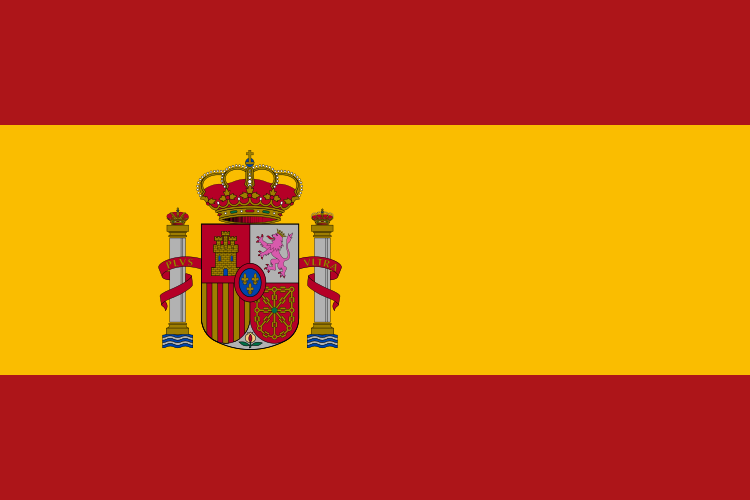
 ESP 16%
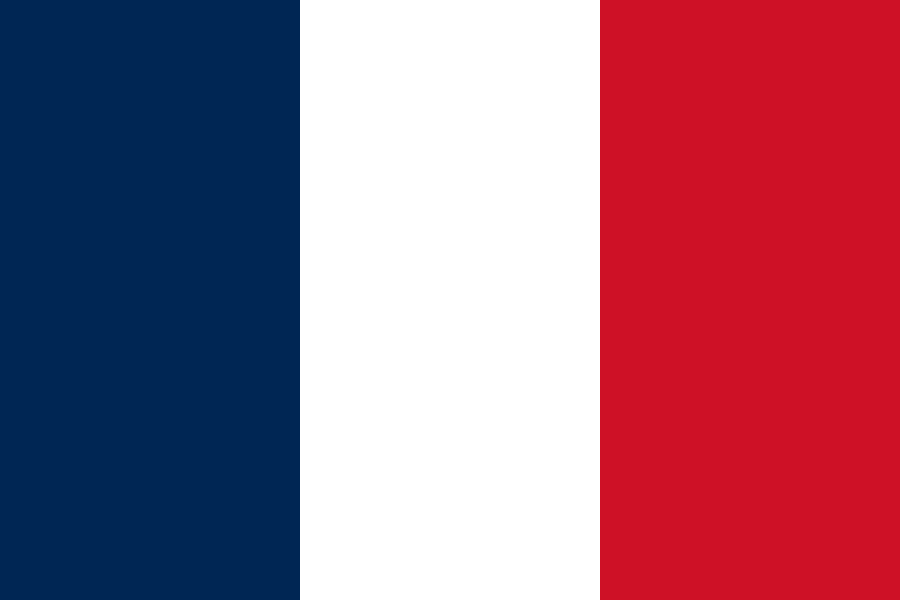 FRA 12%
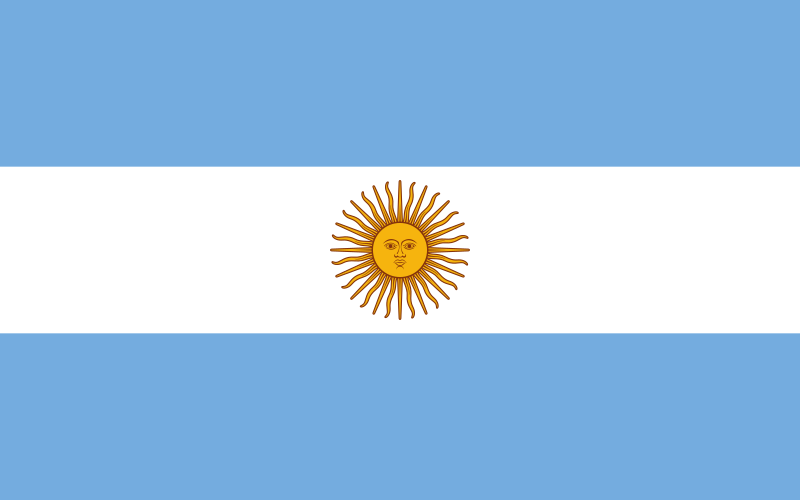 ARG 12%
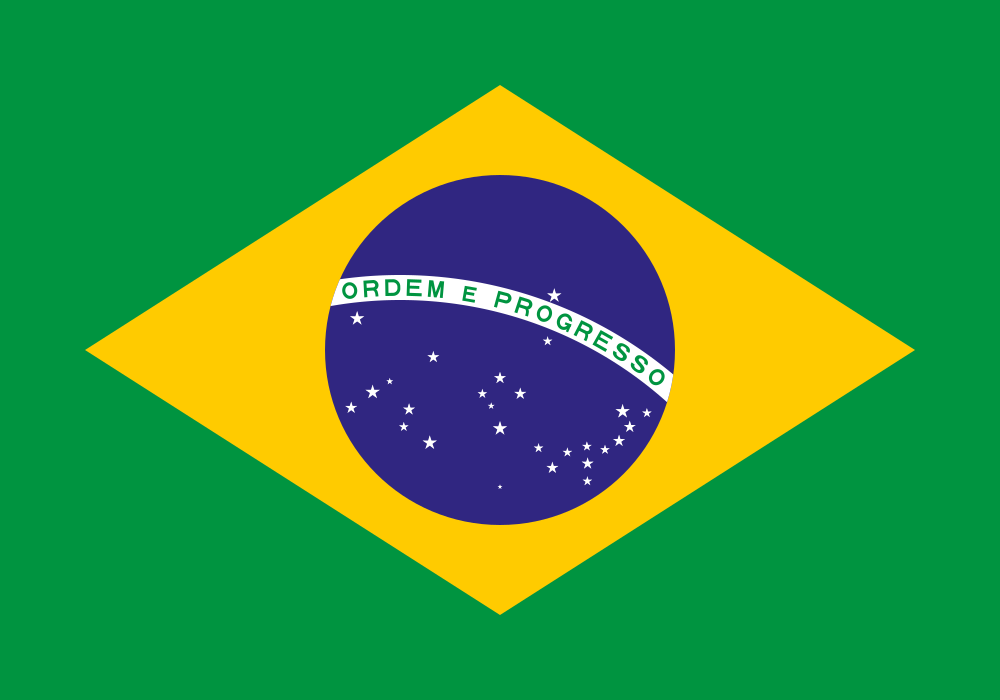 BRA 11%
 ENG 10%
What the World Cup 2026 knockouts taught us: pedigree largely held, penalties settled the tightest ties, and Africa's best reached the quarter-finals.
The clearest lesson from the World Cup 2026 knockouts is that class and ranking still won the tournament's key battles: Spain (FIFA #2, 16% title odds) and Argentina (FIFA #3, 12%) came through 47 knockout matches to meet in a final that finished 0-0, and three of the four semi-finalists (Spain, France and England) came from UEFA. The bracket delivered chaos in the early rounds, but the last four read almost exactly as the pre-tournament market predicted.
That does not mean the knockouts were dull. Far from it. Penalty shoot-outs settled a remarkable number of ties, three of the world's top eleven sides were dumped out before the quarter-finals, and every host nation was gone by the last sixteen. The story of these knockouts is the tension between two forces: the pedigree of the favourites, which mostly endured, and the fine margins that repeatedly threatened to blow the bracket apart.
Below we break down the six things the knockout results actually proved, from the power of penalties to the reckoning across the confederations, all grounded in the scorelines that have already been played.
Ad
Did pedigree hold up in the knockouts?
Broadly, yes. For all the early upheaval, the four semi-finalists were Spain (#2), France (#1), Argentina (#3) and England (#4): the four highest-ranked European and South American teams in the field. The gap between reputation and result narrowed as the rounds went on, and by the last four the cream had risen. Spain underlined the point by beating France 2-0 in one semi-final, while Argentina saw off England 2-1 in the other.
The title-odds picture told the same story. Spain, the Euro 2024 winners and 16% favourites, backed up their billing with a run that never once required a shoot-out until the goalless final. Argentina, the reigning champions at 12%, ground through three drawn or one-goal knockout ties to reach the showpiece. Even the losing semi-finalists, France (12%) and England (10%), were among the five most-fancied sides before a ball was kicked.
The exceptions matter, though. Brazil (11%) and Germany (8%) were both rated stronger than England on paper yet exited in the round of 16 and round of 32 respectively. Pedigree bought the very best sides a deep run, but it guaranteed nothing in a single-elimination format where one flat 90 minutes ends everything. The lesson: ranking predicted the semi-finalists well, but it was a poor guide to who would fall in the opening knockout round.
Why did penalties define the knockout rounds?
If one theme ran through the entire bracket, it was the shoot-out. Penalties repeatedly separated sides that could not be split across 90 or 120 minutes, and they were kind to underdogs and giants alike. Paraguay knocked out Germany 4-3 on spot-kicks after a 1-1 draw, Morocco eliminated the Netherlands 3-2 following their own 1-1 stalemate, and Egypt beat Australia 4-2 after finishing level at 1-1.
The deeper rounds were no different. Switzerland's entire knockout identity was built on nerve from twelve yards: they beat Colombia 4-3 on penalties after a goalless round-of-16 tie, then pushed Argentina all the way in the quarter-final, losing only after another 1-1 draw went the distance. Norway's fine run also ended on penalties, beaten by England after a 1-1 quarter-final. Argentina themselves needed spot-kicks to survive both Cape Verde and Switzerland.
The takeaway is stark for tournament planning: teams that could not defend a lead or force a late winner still had a route through if they held their nerve in the shoot-out. Switzerland (FIFA #19) reached the last eight almost entirely on that basis, and Morocco and Paraguay used the same escape hatch to remove far bigger names. In a knockout of such fine margins, penalty proficiency was not a footnote; it was a core competitive advantage.
Which giants fell, and how did they go?
The knockouts claimed a heavy roll-call of pre-tournament heavyweights. The most eye-catching was Brazil, whose 11% title chance evaporated in a 2-1 round-of-16 defeat to Norway. Erling Haaland's side had already knocked out Ivory Coast to reach that stage, and their win over the five-time champions was the single biggest scalp of the entire bracket.
The round of 32 had already thinned the elite. Germany, an 8% pick, went out to Paraguay on penalties, and the Netherlands (6%) suffered the same fate against Morocco. Two of Europe's most storied nations were gone before the last sixteen even began, both undone in the lottery they could not control. Portugal's golden generation then bowed out 0-1 to Spain in the round of 16, and Belgium's quarter-final ended in a 2-1 defeat to the same opponents.
The hosts fared no better once the knockouts arrived. Mexico pushed England hard before losing 2-3, the United States were overrun 1-4 by Belgium, and Canada were dismantled 0-3 by Morocco, all in the round of 16. Home advantage helped all three co-hosts reach the knockouts, but none could turn it into a place in the last eight. The pattern was clear: reputation and home comfort delayed elimination for the giants, but did not prevent it.
What did the knockouts tell us about the confederations?
The confederation scoreboard was one of the most revealing outcomes of the whole tournament. UEFA dominated the business end, supplying three of the four semi-finalists in Spain, France and England, plus quarter-finalists Norway and Switzerland. CONMEBOL's flag was carried almost single-handedly by Argentina, who reached the final while Brazil, Colombia (out on penalties to Switzerland) and the rest fell away.
Africa's tournament set a firm ceiling at the quarter-finals. Morocco flew the CAF flag furthest, beating the Netherlands and Canada before losing 2-0 to France in the last eight. Senegal pushed Belgium to a 2-2 draw and Cape Verde ran Argentina close, but the continent could not break into the semi-finals. Given six African sides reached the knockouts, that represents genuine strength in depth, even if the very top step remained out of reach.
For Asia and CONCACAF, the knockouts were a chastening experience. No AFC side reached the quarter-finals, with Japan (beaten 2-1 by Brazil) and Egypt's conquerors Australia among those falling in the round of 32. No CONCACAF nation reached the last eight either, despite all three hosts and Panama-slaying campaigns feeding into the bracket. The honours were shared between Europe and South America once again, and the gap to the rest, on this evidence, has not closed at the sharp end.
Which players defined the knockout run?
Individual brilliance shaped the knockouts as much as any system. Kylian Mbappe finished as the tournament's outright top scorer with 10 goals, a haul made all the more striking by the fact France lost their semi-final to Spain and then the third-place play-off to England. Mbappe carried the French attack throughout, but even ten goals could not lift a side that ran out of steam against the eventual finalists.
Behind him, Lionel Messi (8 goals) dragged Argentina to the final in what may be his last World Cup act, while Erling Haaland (7) was the engine of Norway's run to the quarter-finals, including the winner-laden dispatch of Brazil. Jude Bellingham also reached 7 for England, and Harry Kane added 6, the pair driving a Three Lions side that beat Mexico, edged Norway and then won a remarkable 6-4 third-place play-off against France.
Spain's route to the final was more collective, but Mikel Oyarzabal's 5 goals made him their most reliable knockout weapon, and Ousmane Dembele's 6 kept France dangerous even in defeat. The scoring charts confirm a familiar truth about deep tournament runs: elite finishers win knockout ties, and the sides still standing at the end almost all had at least one player among the tournament's leading marksmen.
What does it all mean heading into the final?
The knockouts distilled a 48-team field down to two of the pre-tournament favourites, and the final between Spain and Argentina finished 0-0. It was a fitting conclusion to a bracket in which the tightest margins ruled: the two best-backed teams left standing could not be separated across 90 minutes, just as so many of the ties before them had gone to the wire.
For the neutrals, the lasting images will be the upsets that livened up the early rounds: Norway toppling Brazil, Paraguay and Morocco ending German and Dutch dreams on penalties, and Switzerland's shoot-out heroics carrying them to the last eight. Those results proved that any side can win a single knockout match. What they did not do was change who reached the final, and that tension is the defining lesson of these knockouts.
The overall verdict is that World Cup 2026 rewarded a blend of pedigree and composure. The teams with the deepest talent pools reached the semi-finals, but they got there by surviving shoot-outs, one-goal games and moments of genuine jeopardy. Spain and Argentina emerged not because the draw was kind, but because they combined elite quality with the nerve to win the fine-margin ties that eliminated almost everyone else.
Frequently asked
Which teams reached the World Cup 2026 final?
Spain and Argentina contested the final, which finished 0-0. Spain arrived as the highest-ranked side left (FIFA #2, 16% title odds) and Argentina as the reigning champions (FIFA #3, 12%).
What was the biggest upset of the World Cup 2026 knockouts?
Norway's 2-1 win over Brazil in the round of 16 was the biggest shock, ending the campaign of a side rated an 11% title chance. Germany and the Netherlands both went out on penalties in the round of 32.
How far did the host nations get in the knockouts?
None of the three hosts reached the quarter-finals. Mexico lost 2-3 to England and the United States were beaten 1-4 by Belgium in the round of 16, while Canada fell 0-3 to Morocco.
How far did African teams go at World Cup 2026?
Morocco went furthest, reaching the quarter-finals before losing 2-0 to France. Senegal, Egypt, Cape Verde, Ivory Coast, Algeria, Ghana and DR Congo were all eliminated earlier.
Who was the top scorer in the World Cup 2026 knockouts?
Kylian Mbappe finished as the tournament's leading scorer with 10 goals, ahead of Lionel Messi on 8 and Erling Haaland and Jude Bellingham on 7 each.